Yay happy new year. I don’t like my brain chemistry lately. I have an anxiety disorder that means I do very well when kept desperately busy, but slide into malaise once the pressure lets up. On the plus side, I am managing to use a significant fraction of my newfound free time to write…even if a lot of the rest is wasted on staring at a wall.
Short stories
“The Belle of the Ball” by Stephen Graham Jones
A guy travels back in time through a service geared towards enabling murder sprees in alternative timelines. He’s maybe going to stab his parents to death. I didn’t connect with this one.
A post-war dystopic sci fi about a company town, centered on Rose, an elderly medic who remembers what things were like before, and is seeking a way for her fellow indentured laborers to escape.
“Listener Supported” by Juan Martinez
A story about a man whose radio can tune into broadcasts from the future. He uses it to get advance warning of ICE raids and save others.
“Adventures on the Omega Train at Night” by A. T. Greenblatt
A fabulist story wherein a woman chases her drunk boyfriend onto an interdimensional train, trying to stop him from getting lost for weeks.
“That’s Our Time” by Eric Smith
Another near future sci fi with family themes from Eric Smith. In this one, parents’ fears can cause time to stop for their children, arresting their development. A chronotherapist talks a couple through the issues stopping their little boy from growing up.
“Mail-Order Magic” by Stephanie Burgis
Huh, I’ve definitely read this before, but it’s not in my master document. Anyway, it’s a story about a chronically ill woman who accidentally buys a griffin, which leads her to meeting people.
“All That Means or Mourns” by Ruthanna Emrys
A fungi hivemind short story, set on a near-future Earth devastated by climate change.
A grab-bag of sci-fi concepts about climate change, longevity, mind uploads, posthumanism, and colonizing the galaxy, articulated through the character of Mia, whose birthdays stretch across hundreds of thousands of years. Reminds me of the short animation “World of Tomorrow” by Don Hertzfeldt.
“This Is Not a Space Kidnapping Fantasy” by Priya Sridhar
Donita Inferno was a normal girl kidnapped into a superfamily of aliens hiding on earth. Also, a movie character, whose actress sustained serious burns in what would remain her career-defining performance. Years later, in the aftermath of the convention where the narrator meets Donita’s actress, descending rockets seem to psychically compel the con-goers to meet them. This is about the fantasy of being chosen for a special destiny. Not something I ever coveted, so the emotions didn’t hit for me.
“Regarding the Childhood of Morrigan, Who Was Chosen to Open the Way” by Benjamin Rosenbaum
So, I super enjoyed how quirky this one was. The narrative voice was great; it gave me major nostalgia, though I can’t remember for what. But it’s definitely another installment in the Reactor Magazine saga of “novelettes that wanted to be novels.” The point of the story comes into focus aaaaaand then it’s over.
Books
Spinning Silver by Naomi Novik
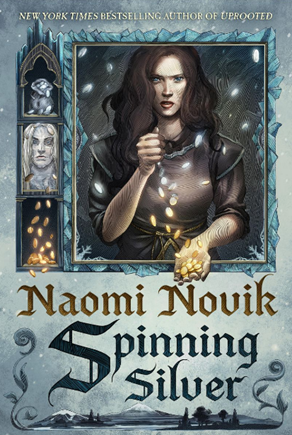
This book was a C+ for me. It’s doing a very loose retelling of Rumpelstiltskin, where he’s the winter fae king, and the woman he ultimately forces to marry him says she can “turn silver into gold” because she’s a moneylender. He gives her silver coins, she has them melted into jewelry and sold to the duke for his daughter, the daughter catches the tsar’s interest because of the jewelry, the tsar marries her, the tsar turns out to be possessed by an evil fire demon. So, we’ve sort of got two parallel “forced marriage” heroines, one to the winter king and one to the fire demon tsar, but that second pair slides out of narrative focus in the end.
Book club pick. My book club was annoyed that the first, like, 150 pages are a “medieval European chore montage.” But I wouldn’t characterize the rest of the book as not being a chore montage. Novik has a huge preoccupation with scene setting via mundane character actions here. They’re always sweeping, sewing, tending animals, cooking, mending, fixing, etc., etc., etc. And I mean always. I think chores are like 50% of the wordcount.
The book’s strongest point is definitely Miryem, the moneylender girl. Novik’s ideas were most in focus when it came to her character arc, as she becomes the queen of the winter fae while fighting to protect her human family. I really liked her. But there are two other heroines she initially appears to be flanked by—an impoverished girl she hires as a servant, and the duke’s daughter who dons the silver jewelry to catch the tsar’s eye—and the book fumbles both their subplots, imo. The servant girl’s younger brother becomes a perspective character and basically edges into her place in the plot, while the tsarina girl’s subplot just gets outright dropped after a pivotal moment. Actually, now that I’m thinking about it, the tsarina’s nanny also inexplicably becomes a POV character (the nanny is of course another vector for Chore Descriptions), supplanting her too. It’s like Novik didn’t have a clear idea for the trajectory of their arcs, so she subbed in peripheral characters. We never do find out what happens to the tsar after Miryem defeats the fire demon, despite that being built up as a major thing, with the tsarina planning for the tsar’s assassination in the few POV scenes she has after the spotlight starts straying to her nanny.
There Is No Antimemetics Division by qntm
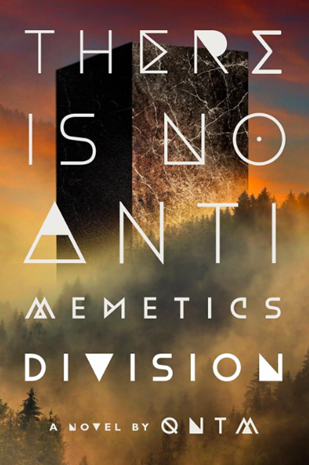
I enjoyed this book a heck of a lot more. Marie Quinn is the middle-aged head of the “Unknown Organization’s” antimemetics division. The UO specializes in dealing with “unknowns”: persons, places, things, and phenomena with supernatural properties. Often lethal ones. Quinn specializes in the subtype of unknowns that prevent you from perceiving or remembering them. Antimemeticists like her are said to only ever be as good as they are on their first day; when the shit hits the fan, the shit is going to prevent you from comprehending the shit. It’s your selectively-amnesiac self, your instincts, and your common sense up against unknowable horrors.
Quinn has this skillset. She is very, very good at improvising in the kind of crisis that won’t let a person remember context for the crisis. I loved her as a heroine.
The plot arc gets weird. It worked for me emotionally, despite that I don’t think the story logic of the antimemetic unknowns always tracked. Imo, cosmic horror should get a bit of a pass on this; it’s hard to write books about stuff that’s supposed to be beyond human comprehension. What this book nailed was a ‘save-the-world’ plot where the main character was 1) pivotal and 2) kept in focus. Kudos.
FYI: This book grew out of the SCP Foundation, a wiki-based collaborative writing project with effectively the same premise as the “Unknown Organization,” but where different users are writing entries about various supernatural phenomena that must be secured, contained, and protected against. Quinn’s story was originally a shorter, less focused webnovel, which I still enjoyed.