You know when you’ve written a weak chapter. Even after toiling for ages, something will feel off. But who has the energy to identify the underlying problem, much less fix it, after struggling just to get the words down on paper?
The third chapter of The Magician on Anise Street was like this for me. Individually, the components should have worked. There was no reason for it to drag. The chapter had a lot of jobs, and the original draft accomplished them all in under 3100 words. Still too long for middle grade, but acceptable for an early draft.
By way of opening, chapter 3 established the protagonist’s chief anxiety—starting a new school—through exploring his stress from moving to a much smaller home, and his relationships with his family.
In the original draft, that went like this:
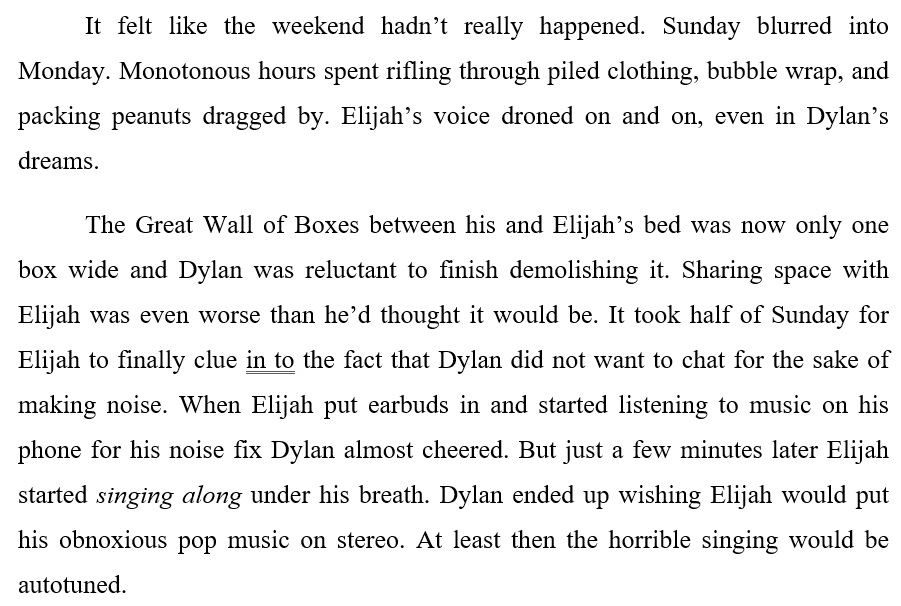
Not bad. But it continued on like that for another two pages. We learned about their father, Frank’s, efforts to make himself useful despite his bad knee, and saw Dylan help his mother in hang mezuzot in Frank’s place.
Earlier chapters had already shown that Elijah was obnoxious, Frank struggled with his knee, and Dylan liked to be helpful. So many of the details in the opening of this chapter simply weren’t necessary. They added flavor to the characters, true, but they didn’t drive the narrative forward.
So, this whole section got the ax. Instead, I moved up the final scene of the chapter. The cliffhanger became the hook:
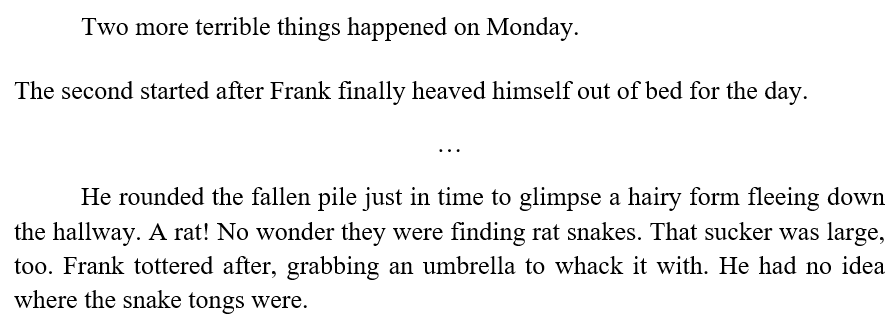
We see Frank fail to confront a strange creature loose in his mobile home. In the original draft, the chapter ended on the creature’s escape. That worked well as a cliffhanger. But what didn’t work was when the chapter overtly switched to Frank’s perspective for that final scene, after being in Dylan’s for the first two.
So I swapped the order of Dylan’s and Frank’s scenes. This is how I restructured the transition:
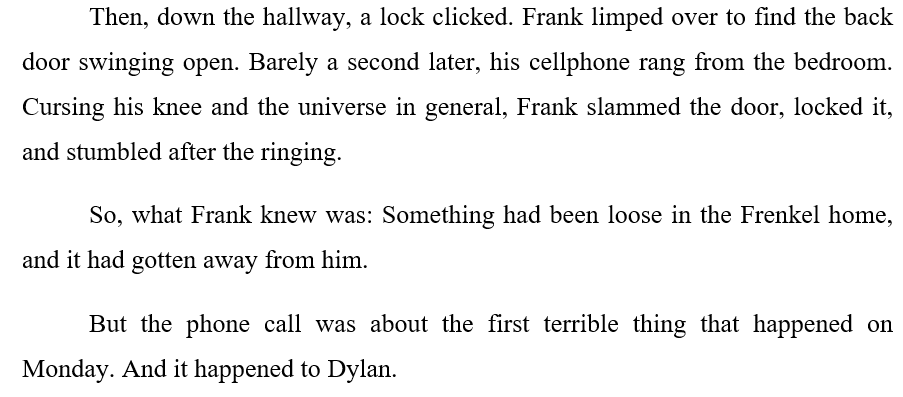
This is a much better lead-in to the other main event of the chapter. On Dylan’s first day of school, his anxieties are realized when another boy, Glenn, somehow manages to frame him for fighting in front of a crowd. Since the next chapter will see Dylan in the principal’s office, facing the consequences of that event, it’s clear that Frank’s scene should never have been in between the staged fight and Dylan’s subsequent suspension.
But I was too close to the story to realize that. I presented Dylan’s bully problem before Frank’s creature problem because that was how they happened chronologically. The creature escapes just as Frank gets the phone call about Dylan fighting at school.
It was several revisions and beta readers later that I had the epiphany needed to solve this chapter’s problems. Initially, I worked too hard on fixing what was already in the story, instead of interrogating whether those elements had earned their keep. This chapter stayed borked for over a year.
And you know what would’ve sped revisions up? Opening a new Word document. I’m serious. I hit upon this trick when revising sections of an adult fantasy duology that I drafted with a coauthor in Google Docs. Google Docs throws fits when long documents are revised too many times, so it was easier to create clean versions.
Turns out, when I wasn’t staring at what I’d already done, it was easier to get my brain out of a rut and jump to a creative solution. I highly recommend this to anyone struggling in the revision process. Those old passages will feel immutable because of their familiarity— So don’t focus on them. Your instincts have been honed by experience from every paragraph you’ve written since. Just ask yourself how you would tell the story now, staring at a blank page.
Odds are, the things that you remember off the top of your head are what deserve focus. The rest may be chaff. Don’t be afraid to winnow.