I read a crap ton this month, but it was 90% stuff I can’t talk about. I joined the team going through slush for Translunar Travelers Lounge. TTL is a speculative fiction magazine focused on “fun” stories. Lest ye sin, remember, always follow the submission instructions. A surprising number of people do not.
Short stories and essays
“Rediscovering a Radical Piece of Early Science Fiction” by Ilana Masad
This was interesting. Masad makes a convincing argument for a trans reading of the 1929 book Out of the Void. This made me nostalgic for O Human Star.
“Model Collapse” by Matthew Kressel
A short horror story about a girl being trained as a special agent dealing in weird phenomena (think SCP Foundation) and her mentor, who’s inducting her into the secret of a strange town. Ultimately, it got goofy about AI, and a large chunk of the story is just the mentor leading the girl into explaining the premise’s mystery. And I still can’t tell what it was trying to say.
I’ve seen “I can’t control my body” stories before, and “the mind is a figurehead who only thinks it’s in charge,” stories, and “my limbs have minds of their own stories,” but never this all in combination. The narrator is a medic who, after an accident, has to treat the parts of her body like cats who won’t be herded. On top of that, there’s also a plot! When a gas explosion occurs onboard her spaceship, the narrator, who was a medic before her disability, would like to leap into action. All in all, the execution’s great and the piece comes together for a nice ending.
“The Care and Training of Hellhounds” by Cynthia Zhang
Hades and Persephone as a modern lesbian couple. They’ve just adopted Cerebus, who needs dog training. A slice-of-life story.
I really wanted to like this one. It’s got a pretty cool concept. 100 meters below every ocean in the world, you hit a portal to outer space 45 billion lightyears away. So we installed our internet cables to run through that space. I guess the portals form a continuous surface on the other end too? If the Indian Ocean connected to a patch of outer space a kazillion miles from the Atlantic, this scheme wouldn’t work.
Anyway, this story wanted to be both an exploration of weird sci fi and an introspective character piece about a hermit-type guy who’s been struggling with the departure of his wife. He lives and works repairing cables on a two-man sub. She decided to move back to Arizona. He doesn’t really understand his new partner, her replacement, and also worries he didn’t understand her.
This piece lacked focus. It also does the very Kim thing where the narrator bounces us around microscenes. Missing the wife to the ship to the history of interstellar internet cables to the wife to the ship to the new partner to the narrator’s psyche to the ship to the wife and back again. A ton of the story takes place on the ocean side of the weirdness. But, for all the wordcount spent on scenesetting, the boat’s never made to feel like a boat. There’s also a disaster with meteoroid strikes, and if I took too long to mention that tidbit, I at least got to it quicker than the story’s narrator did.
“Why A.I. isn’t going to make art” by Ted Chiang
This boils down to, “A.I. is incapable of intentionality in what it produces,” either process-wise or product-wise. And yup, that’s why I have no interest in AI stories. Why the heck should I read something that someone couldn’t be bothered to write?
I love Anaxagoras’s humor. I’m gonna read everything of his forever. This story is about a Doordasher having a rough fucking night.
Magazine featuring very short nonfiction. Recurring themes in this issue’s stories were death and dementia. There were a couple of stories told as run-on sentences, which is not my thing, and an experimental story featuring dictionary definitions, which was also not my thing. I connected best with “Lebanese Eggs” by Marjie Alonso and “There Will Be Plenty of Time” by Heather Shaw.
“Laurie on the Radio” by Sam Davis
A story about a family of “vespers” in a world of human-like insects. They wear clothes, live in a city, etc. Elements include insect social inequality, modernity, and invention. Dad is an engineer who made the first synthetic cloth. His daughter Laurie is in the (literally) underground music scene, and first got famous for a radio jingle she did for his product. The story does some weird stuff with music, transcendence, and a giant saturnalia of sticky insects crushing downtown.
“Never Eaten Vegetables” by H. H. Pak
Loved this one! A natal ship delivering embryos to become the population of a productive colony planet experiences an error: Five hundred embryos enter gestation way too early. Visceral prose describes the process. Really nails the urgency of the situation. All of the worldbuilding is on point, really. AIs attempting to raise babies is a story premise I’ve been noodling with since 2018. In Pak’s take, the natal ship AI strives to improvise care for the gestating fetuses with the help of other AI. The company considers her insubordinate for not flushing the developing embryos to save the far more numerous frozen ones. Instead, the natal AI does the reverse.
This is a dual timeline story about the origin and future of the colony’s first generation, the embryos the natal AI saved. The AI’s actions, in the company’s eyes, “doomed” the population—There are too few survivors to meet production quotas. Once the first generation reaches adulthood, Luwa, who grew up to be the colony’s representative, investigates what really caused their premature births. Pak does a great job digging into the intended themes here. Highly recommended.
“Large Emotional Models” by Cecilia Tran
A trans linguist studying in Helsinki after fleeing America picks up a Prince impersonator at a club. Maybe because of aliens. A really nice story; I linked this to a friend immediately.
“Cinderella’s Cat Child” by Sarah Allison
A great explanation of this type of folktale. I always enjoy Sarah’s writing.
“The Hungry Mouth at the Edge of Space and the Goddess Knitting at Home” by Renan Bernardo
A short story about a ghost on a spaceship, the life she lived, and the goddess who raised her. I had a hard time following what was going on tbh. But maybe that’s because I got interrupted approximately 53 times while reading these 6,000 words.
A Guardian article by and about Elizabeth Gilbert
I would’ve made some assumptions about the Eat Pray Love woman, based on my shallow understanding of the book as being to moms at Target what corn cobs are to deer. None of those assumptions would’ve led me anywhere in the vicinity of guessing that Gilbert was in a lesbian relationship with a cocaine addict until that woman’s (tragically premature) death.
Gilbert’s a damn good writer. This article was a ride.
Books
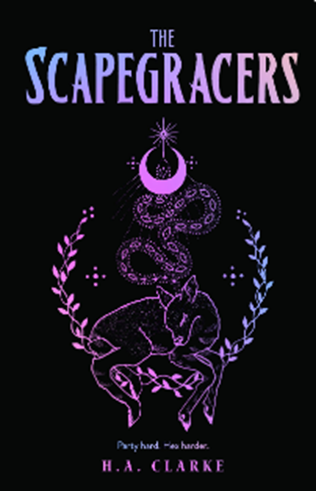
The Scapegracers by H. A. Clarke
I’ve been meaning to get to this one forever. It came highly, highly recommended. Unfortunately, what I learned from this is that I’m not into teen witches. The Scapegracers are a coven formed by Sideways Pike, inveterate outcast (except she makes three BFFsies in the first act of the book), after she successfully performs magic at a wild Popular Girls’ party.
The world of Scapegracers is all about teen girl wish fulfillment: special powers, killer outfits, intense friendships, partying, driving fast, having a big secret exciting life outside of school, inspiring awe in your peers, cursing jerkhead boys, etc. Unfortunately, I can’t say I was really ever a teen girl, so. Good for Sideways and Co., I guess?? God, I’d hate to know them.
I think this book hits better if you’re someone who enjoys holding anger between your teeth. Sideways (and her buddy Daisy, to a greater degree) revels in anger. Clarke very much lives in Sideways’s skin throughout this book. That’s what I think people love about it, but for me, as a reader, that profound demonstration of connection is sometimes to its detriment. Sideways is richly realized. That doesn’t make the texture of her life interesting. Somewhere around the 65% mark—when it’d been a good long while since I had a guess for where the story wanted to go—there were seven consecutive pages about her morning routine, and I was like, What is happening.
While the book finds its footing for the finale, the beginning is suuuuuuuuper drawn out and the middle dithers badly. Those many times I was asking myself what the plot was supposed to be, I think the reader’s investment needed to hinge on wishing for Sideways’s desires alongside her. (Instead of my natural reaction, which was clucking my tongue and wishing this kid would like, disconnect for a fishing trip to get her head on straight.) Sideways was all, “My new friends are fierce and wonderful. I can’t believe the popular girls like me. We are ferocious and intense and powerful together. The other kids at school are dumb and so is class, which I don’t pay attention to, because I’m here with my beautiful and fierce and electrified BFFsies, and we are all so scary special. But also I am now again having insecurity about whether they like me.”
My favorite plot point was the fallout from when, SPOILERS, Sideways got dumb about an intense teenage crush, on a girl who predictably betrayed her. It felt very true to life for Teen Brain Syndrome to lead her by the nose into that class of consequence (with added magic soul-stealing for flavor). (Caveat: I’m not speaking from personal experience here. When I was in school, and saw my peers getting taken out at the knees by crushes on our fellow pubescent pimplelords, I was like, Egads, let’s not, and didn’t.)
Anyway, the tl;dr is that you should definitely read this if Teen Girl Havoc and Teen Girl Wish Fulfillment resonate with you. The book’s much harder to get through if you are boring like me, and need a plot with a focused narrative arc. Scapegracers is a yarnball sloppily spooled on witchiness and feminine angst. The narrative tangles around in its (small) world, loops back on established Sideways things, and drops threads that seem like they should’ve been important. Such as the antagonists introduced at the halfwayish mark. Preceding the finale, rather than having momentum, the story accelerates in the way you’re supposed to understand the concept from physics class: the velocity’s changing all over the place. But not everyone will be bothered by this, so give it a shot if you want. If the first 100 pages hook you, you’ll make it through.
Beware, though: The finale’s main job is setting up for the sequel. I actually think it assembled a good set of plot hooks, but not good enough to bring me back for round two.