This is like 6k words. If that sounds nuts to you, I agree. Go read the short version.
I meant to write this post two years ago. Sorry. Life finds a way. To be horrifically busy, I mean.
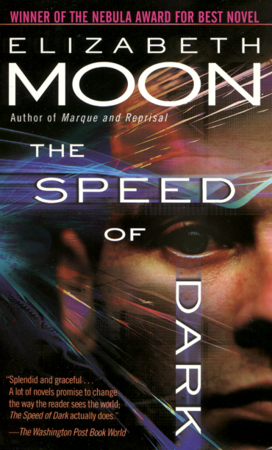
Herein, as an autistic writer, I will pick apart discuss the portrayal of autism in the main character of The Speed of Dark (2002), by Elizabeth Moon.
THE BACKGROUND
Wayyyyy back in the yore of 2024, I read roughly 30% of The Curious Incident of the Dog in the Night-Time and wrote a blog post about that book’s portrayal of an ““autistic”” main character. Now, well after everybody else forgot that I said I’d make a follow-up post, here that is.
The reason I’m doing a ‘series’ like this is because I’ve been kicking around a writing project narrated by an autistic main character…but I have spent my entire life (which includes all previous writing projects) developing muscles to hold myself back from sounding autistic. I am triply diagnosed. I grew up in the 90s – 00s. Sounding autistic was bad. It got me in trouble. Didn’t talk enough. Overcorrected, babbled, got shut down. Told I was too cold or too flat or too affectless or too atonal, or obviously insolent, or upset for “no reason.” Friendless weirdo freak, etc. You don’t need me to explain the concept; you’re here on the internet too, reading a web essay on WordPress! 😉
It goes against my instincts to purposefully write an autistic character. If it wasn’t for every second peer encouraging me to #OwnVoices up my work, I’d be telling folks I was the most neurotypical normal normie to ever grill a hamburger, scout’s honor, go Cardinals.
Authenticity is raw and painful. (For everyone.)
But art must go on. I’ve just gotta write this autistic character with a safe degree of separation. That means I need to get a handle on things my brain does that I can shave off and repackage. What about my perspective is down to the autism, transferrable, and, most importantly, recognizable? Cuz the second edge of the blade is being told that no, I don’t sound “really” autistic, and therefore must be a lying liar, per the scrupulous judgment of Joeniffer McRando.
So, during Q3 of state FY2026, I finally read/studied/absorbed The Speed of Dark, a famous “autism book,” to see what Moon did with her autistic POV narrator. Dumb move on my part, vis-à-vis timing. I know full well I don’t have time in Q3 to pencil ‘thinking’ into my schedule. Then, also, it took me about six weeks to get ahold of a paper copy I could mark up with notes— During which I forgot nearly everything I’d thought about this story. My big emotions went stale. So I had to reread.
(That sentence was written in March 2026. It is now July! Yay!!! I love the linear passage of time!)
I also reread Flowers for Algernon, and now I’m flipping back through everything, trying to recreate what was in my head three four five six months ago.
Okay. Deep breath.
THE BOOK
The reason Flowers for Algernon matters is that The Speed of Dark is billed as “Flowers for Algernon, but for autism.” If you didn’t get to know Algernon through assigned reading in high school, here’s the cliffsnotes: Charlie Gordon, IQ 69, volunteers as the first human test subject for an experimental treatment to vastly increase intelligence. (A “cure for mental retardation,” in-universe.) Charlie keeps journals of his experience that track the rapid ascent of his genius, and the concurrent emotional and social problems as he starts relating—and failing to relate—to people on levels he couldn’t previously imagine.
Algernon is a mouse subject of that same intelligence treatment. The only living thing in the world that can understand what Charlie’s been through, in his own words.
You can guess what happens to Algernon from the title.
Flowers for Algernon is unequivocally great. The novelette version won a Hugo in 1960. The novel version won a Nebula in 1966. The Speed of Dark also won a Nebula, in 2003. But, compared to Flowers for Algernon—well.
What if you could get your autism cured??
That question is typically followed up by people asking, “But what if that completely alters my sense of self, my personality? What if I lose who I am?”
In The Speed of Dark, Elizabeth Moon answers that with, “Worth it!”
When that answer comes, it hits like a clothesline.
Let me get into it.
In The Speed of Dark, our Charlie Gordon is Lou Arrendale, an autistic informatics specialist. His job sounds like what the people in Severance do: work with patterns that other people can’t see, in ordinarily-incomprehensible data. Unlike in Severance, this is a really good job. Lou lives like a bachelor in a nice apartment, owns a car (a big deal in this imagined future), and has friends and hobbies. This is a successful guy. The book tells us that he’s doing a lot better than plenty of ‘normal’ people.
As for his POV— It’s great. When I first started reading, my impression was that Moon was nailing it. The beginning was full of promise.
The first thing that hit for me, on page one, is when Lou asks, “If they aren’t going to listen, why should I talk?”
The story opens with him in his mandatory quarterly therapy appointment. His therapist sucks. I’ve been through these exact fucking sessions, as a kid. The sheer disrespect on display is even more grating when directed towards an adult.
The therapist isn’t interested in her client. Lou’s aware that he’s not a person to her, because he fails at being the way the majority of other people are, which is the right way to be. He tells us, “I know better than to say [why should I talk if you aren’t going to listen?] out loud. Everything in my life that I value has been gained at the cost of not saying what I really think and saying what they want me to say.”
Ouch. That hits.
I wish all of The Speed of Dark was like this. But the glimmers of brilliant insight—they’re sporadic, shifting. The book is a mixed bag on the whole. Like, a bag with five different kinds of old gorp dumped in. Sometimes you get a peanut butter cup, sometimes it’s suddenly Chex Mix, or stale Lucky Charms. Or you could bite down on a rancid peanut.
THE GORP. I mean substance.
I’m going to go from bowl to mouthful to bite—big picture to granular. Let’s start with the title, simply because Lou, our narrator, never shuts up about it.
The idea is that dark is actually faster than light. Because, when light gets somewhere, darkness is already there. This is straight from Pratchett. (On purpose? IDK.) Reaper Man, 1991: “Light thinks it travels faster than anything, but it is wrong. No matter how fast light travels, it finds the darkness has always got there first, and is waiting for it.” Lou repeats variations on this point approximately eight hundred thousand times.
Other than that fixation—which made me feel like we spent weeeeks searching a kiddie pool for the deep end—Lou’s POV had a lot that seemed real to me. The way he processes emotions, the way he interfaces with the world. His therapist doesn’t ever realize that he’s not an empty skull, but a black box. Since she’s not looking, he reads her better than she reads him. He tells us, “Autistic persons do not understand these signals; the book says so. I have read the book, so I know what it is that I do not understand.”
Yeah. That’s exactly it. Damn. Elizabeth Moon even touches on how, when you’re autistic, innocuous behavior is pathologized. When the therapist does something, it’s normal. When Lou does basically the same thing, it’s a Symptom.
This is the point where I checked whether Elizabeth Moon is autistic, because she was so thoroughly getting it. I was a little crushed to find out it’s not her; it’s her son. She wrote about raising him on her blog.
Most pertinently, she said:
“All autistic individuals I know about—and the parents of autistic children—agree that autistic people perceive the world a little differently than the average at the sensory level. That is, the primary raw sensory data is not getting to the central processor in the same way that it gets to the average brain. The odd patterns of extra sensitivity and insensitivity that autistic children display reflect this, as do the subtle (and sometimes obvious) differences in their patterns of attention and movement.”
She goes on to expand this. The whole while, I was thinking, yeah. Yeah, that’s really fucking it. Moon does a great job synthesizing these understandings into Lou’s perspective. Light, texture, scent, movement, music, time, and his body in space—all of it. All autistic people are different, I can’t speak for everyone, etc., but I’m saying, if you want a primer on how to write an autistic POV, pick up The Speed of Dark.
And try not to throw it at the wall if you read past the early chapters.
WAIT, WHAT HAPPENS?
The narrative is mostly about Lou’s life, so here that is:
Lou is a creature of routine. He drives to his office in the morning, puts his music on, hyperfocuses at his work PC for hours, eats dinner at the same pizza place, grocery shops on Tuesday, has fencing club on Wednesday, and goes to church on Sunday. This has been his life since his parents passed.
He’s good at his job and paid well for it. Importantly, he has accessibility supports: a private office, a gym shared only with his section members, reserved parking, and a cafeteria. These supports keep him productive. He gets to avoid crowded, noisy, public spaces that stress him out, like a cubicle floor or the bus, and can spend time in the gym when he needs to center himself.
Here’s what I thought was interesting: the other people in Lou’s section are also autistic. “Section A”—the autists who comb data for patterns and write algorithms to utilize them. Unfortunately, Section A’s boss gets a new boss, Mr. Crenshaw, and that guy hates this whole setup.
Mr. Crenshaw is one of those people who resents accommodating anyone. The curb cutter effect would probably make him retch. Disability supports are a waste of the company’s precious money—never mind that everything Section A utilizes was paid off ages ago. Really, what pisses Crenshaw off is seeing someone else get “entitled.” Entitlement is only for him! Nothing Lou’s immediate boss says about their productivity—or the tax break the company gets for employing disabled people—can sway him.
Per Lou: “It is the pattern of people who do not really believe we need supports and resent the supports. If I—if we—did worse, they would understand more. It is the combination of doing well and having the supports that upsets him.”
In taking over Section A, Crenshaw’s pet project is to force his entire staff into being guinea pigs for the autism cure, under threat of being fired.
You’d be forgiven for thinking the book is about Lou navigating this situation. But actually, it’s at least 70% about his fencing club.
BACK TO THE AUTISM
You’re probably reading an ‘autistic representation in fiction’ article because you’re curious about exactly that. Let’s circle back to what Lou’s like.
THE GOOD
Starting with the things that I think hit the mark, and how they’re showcased, narratively:
- Sensory processing differences
- Lou’s constantly paying attention to textures, smells, sounds, and light. He doesn’t filter these things out reliably; they can distract him during conversations. I recommend using this tactic when writing an autistic POV because it also lends itself to some nice viscerality and sensory descriptions. It’s immersive.
- It’s also emotional—Lou has a love interest, his good friend Marjory from fencing club, and his POV spotlights all the little details about her whenever they’re together. The sheen in her hair, her scent, her everything. He’s transfixed by these things. That should be familiar to anyone who’s had a crush.
- Coping mechanisms
- Whenever Lou’s upset, he turns on classical music. His calmdown ritual is to bounce on an exercise trampoline with his earbuds in. This is believable characterization, and also an opportunity to showcase a unique personality. Dr. Mel King (The Pitt, 2025, TV series,medical drama) has her lava lamp videos. When I was a miserable teenager, I played through all the maps on Left 4 Dead (2008, videogame, cooperative first-person shooter) about a zillion times each. The calmdown mechanism must be repetitive but still engaging. Distractions blunt negative emotions for everyone, but autistic people usually go for familiar rituals. Stuff you can do with two brain cells—cuz normal processing is burden enough. (You know how some people swear by “retail therapy,” and haul themselves to the mall to get over a crying jag? That’s an example of a bad fit for us autists.)
- Attention and focus
- Lou tells us that Bach synergizes with the pattern-matching he has to do for a particular work project. The way that Lou uses music like another limb stretches my suspension of disbelief. But maybe that’s just me. It read well enough.
- It’s true that autistic people, like ADHD people, are known for hyperfocusing.
- Justice sensitivity
- Also rang true, though I don’t know why autistic people are like this! There are a lot of dimensions to justice sensitivity. Lou holds to his personal values. He cares about fairness. He’s honest and strict about it, down to minutiae. When he’s an hour and seventeen minutes late to work, he stays an hour and seventeen minutes to make the time up.
- Maybe it’s more that everyone’s sensitive to unfairness, but autistic people, who can be worse at regulating their emotions, have trouble tempering their reactions? Maybe it’s that we’re more willing to “rock the boat,” being less attuned to social norms? Autistic people may be more likely to call out injustice, get mad about rulebreaking, and refuse to let things slide. In a way, these are examples of empathy. On the other hand, these reactions can look like someone persevering on a topic against common sense, past the point everyone else in the room has been made uncomfortable.
- Autists also stereotypically have a “black and white” (inflexible) sense of right and wrong. Lou manifests this when he refuses to believe that his former fencing club buddy is the other antagonist in the book. What was done is terrible; ergo, it can’t be his friend who did it, because his friend is not bad. Though this line of thinking makes more sense for a child, to be honest.
- Intelligence
- Moon understands that autism isn’t universally linked with intellectual disability or savantism. Though she makes Lou a genius at patterns anyway, and showcases this through his fencing and applications of math. However, in the area where he really blows the side characters away, he’s shown working hard to acquire those skills—
- Focused interests
- Once Lou becomes aware that he’s being pressured to ‘volunteer’ for the autism cure, he sets out to learn how his own brain works. He does this by starting from a high school level biology education and spending hours every evening reading, working his way up through recommended texts, until he’s basically completed an undergraduate curriculum inside of a month. Then he goes even further. This is recognized as genius by his close friends, a married professor/researcher couple who run his fencing club. It’s well-known that autistic people often dive into a special interest. (Though that special interest doesn’t have to be useful or ‘smart.’) I think there’s maybe some overlap with coping mechanisms here. A special interest is a topic you enjoy thinking about, so you reach for it when you want to feel good, so it’s also a coping mechanism. And we love our ritualized coping mechanisms, so we squeeze them for all they’re worth. Time dedicated = obsession = expertise. See: hardcore anime enthusiasts.
- Social anxiety
- I gotta give Moon this one. Yes, being on a different wavelength from other kids during your developmental years, expressing/experiencing emotions on a different register, and the resulting social isolation will fuck you up.
All of this combines to give us a convincing picture of an independent, autistic adult with Lou’s job. Even the iffy stereotypes make sense in the context of who he needs to be for the book’s plot. So far, so good!
THE BAD
That being said…
- Why the hell is Lou always COUNTING EVERYTHING. Why is this always the go-to sign of autism in fiction?
- I asked the group chat. Apparently, this is the fault of Rain Man (1988, film).
- Look, how many people like this do you know in real life? How many savants do you know in real life?? Those numbers are zero for me, the autist who hangs around other neurodivergent people.
- Just don’t do the counting thing as a default autism trait. Not saying you can’t have an autistic character who’s aware of the number of tiles on the wall or cars in the parking lot, but do it completely on purpose. Have a point.
- CONTRACTIONS – I’d like to buy an apostrophe for $500. It is a shame I can not afford two.
- The strat that Moon picks for giving her autistic characters stilted speech is to limit their use of contractions. All of them. Firstly, it’s nice when different characters have distinct voices. Secondly, why??
- Because this stiltedness is standing in for abnormal prosody. “Abnormal prosody” = talking weird. Prosody is intonation, rhythm, volume, etc.—characteristics of speech. If you want to write an autistic character, have fun with this. Custom tailor the quirks. Speech is super nuanced and complicated and influenced by social norms. Ergo, it’s one of the most noticeable things that people with the “bad at social norms” neurotype miss the mark on, particularly in childhood. There are markers of “autistic speech” that crop up commonly. You can listen to some podcasts or YouTube videos made by autistic people to get a feel for them. But no two people will be wholly alike.
- FIGURATIVE LANGUAGE ‘is a beast.’
Huh? It’s a beast? What does that mean? The autistic character muses, “It is not literally a beast. Maybe they are saying that it is large. Or that it is intimidating like a beast—”
Oh my god. Just, enough of this kind of thing, please.
- It’s rules. Language use is rules. Who wants to say with their full chest that autists are bad at rules? Does that square???
- Lou is so smart. He reads books. Why is he struggling with cliché turns of phrase in his 30s?? Why does he have to turn to the camera and break them down whenever they appear?
- I thought it was a stereotype that autists are known for using figurative language oddly, not for completely failing to grok it. (The group chat can’t decide whether I’m wrong.)
- Also, for like three pages, the autistic characters have their own “private language.” I think this got dropped because having them bother to invent a second language doesn’t fit with the idea of them not fully grasping their first language, or with them not really talking to each other much.
4. Lou does not know this human emotion you call HUMOR.
- What a chronically unfunny guy. He points out all the times he doesn’t get jokes. Really feels Moon’s going the Beep Boop Human Robot route in this regard.
- If autists weren’t funny, where would The Verge get content?
5. The lead shield between Lou’s brain and the concept of SOCIAL SIGNALS.
- What happened to, “I have read the book, so I know what it is that I do not understand”? As The Speed of Dark goes on, Lou’s characterization segues into someone whose head is about fifteen feet under the social signals whizzing around. He constantly tells us he doesn’t understand, but he seldom speculates on what it is he doesn’t understand, outside of “Oh no what if they’re mad at me.” The “oh no what if they’re mad at me” is realistic, but also, surely the guy who reads a biology textbook in three days can apply some of his intellect to improving his theory of mind.
- Seriously. There are flashcards for this. Little children are drilled on them. And the gold standard is asking. That’s such an easy rule to memorize. C’mon.
6. Beep boop robots again – Autistic friendship is a misnomer
- The autistic characters aren’t really friends.
- They understand each other, but that looks like not talking when they hang out.
- This understanding of each other evaporates in a late scene where one of the autistic characters reveals he’s actually upset that his fellow autists aren’t more considerate, like neurotypicals are.Anyway— There’s an early scene where Section A goes to their designated pizza parlor and eats in silence. This made me roll my eyes. I showed the scene to my husband. He also rolled his eyes. “What would actually happen,” he said, correctly, “is that they wouldn’t shut up!” (This wasn’t a targeted attack on me! He also has an autistic brother.)
- You try to get a tableful of autistic people together and not end up listening to an excited monologue about the entire plot of the Gundam franchise, or homebrew Dungeons & Dragons classes, or their childhood trauma, or the HDG web series. Go on. I double dog dare you. My friend’s usually-reticent autistic eight-year-old has the lore wiki for The Amazing Digital Circus memorized, particularly all the corporate conspiracy parts. He related it to me in full. (This was adorable.)
7. Perpetually ARRESTED DEVELOPMENT
- Did you know that there are Reddit boards for gaming out how to improve social skills? Easy, actionable advice, sitting out right there in the open, and I’ll attest that some of it even works.
- The book doesn’t acknowledge the notion that Lou could improve his social competence in any regard. Lou’s just stuck. He’s bad at close friendships, lives on a different planet from the concept of emotional intimacy, and is explicitly incapable of romance.
- In reality, even if you suck at something, you’ll get better with effort. Wild concept, I know. Lou’s interpersonal skills should have matured, because that is simply how life experience works. The dude’s like, 30-something.
- In the context of his big crush on Marjory, Lou mournfully thinks to himself that he could never have a wife, since he can’t handle sharing living space with another human. Maybe that was an autistic stereotype before the Great Recession. In this economy, you suck it up.
THE UGLY (the plot)
The plot is Lou’s fencing club. I’m serious. Crenshaw’s eugenics scheme barely blips on and off his radar for a good 3/4 of the book, because the “autism cure” subplot is partially told through Lou’s sympathetic boss’s perspective.
It’s crucial to understand that this story is not taking place in a world wholly like our own. I said eugenics. There are all kinds of sprinklings of eugenics in here. “Certificates of stability” being needed for marriage are mentioned. The main speculative element is that we will cure autism in the future. Don’t lose sight of this.
You see, Lou is one of the last people to even “need” the cure for autism. He’s also already beneficiary of futuristic early childhood treatments for autism. (Are we supposed to think that he couldn’t have achieved his level of functionality without treatment…? Like, just saying, I don’t remember my therapists doing anything helpful.) A few years after Lou was born, early childhood intervention advanced to the point of shepherding autists through normal brain development, virtually erasing their symptoms. There will be no more autistic generations. Okay…
More darkly, we’ve also developed a brain chip that corrects personality problems by restraining behavior! What a neat thing to have matter for the span of approximately two chapters. Moving along—
~~Spoiler time!!!~~
The cliffsnotes:
Once upon a time, there was an autistic man named Lou, and he was soooo good at pattern matching that it made him awesome at fencing. He impresses everyone at his fencing club with that, and his diligence. Lou always does his stretches. The pretty lady Marjory notices how diligent and good he is. They start casually hanging out, on the level of acquaintanceship. That gives Lou tremendous amounts of butterflies that he just can’t ever cope with. So tragic.
Simultaneously, the fencing club organizers convince Lou to try out tournament competition. He does well. He’s encouraged to keep competing. But, alas, his autism is an insurmountable obstacle to him dating Marjory or participating in tournaments. These things are wretchedly anxiety-inducing the first time Lou experiences them; ergo, they will be impossible forever.
But he looks successful. And this makes a man named Don jealous. Don’s in Lou’s fencing club, but he sucks. He feels worse about himself knowing that someone like Lou can accomplish things he fails at; he wants to be Marjory’s boyfriend; and he lacks any capacity for self-improvement. Don is explicitly neurodivergent. He’s portrayed as having ‘dark triad’ personality traits. (Moon doesn’t use that descriptor.)
The central conflict in the book is Don’s furtive, escalating harassment of Lou. First, he slashes Lou’s tires. Then, he smashes Lou’s windshield in a drive-by. Lastly, he replaces Lou’s car battery with an explosive device. The police have become involved by then, and have drawn the obvious conclusion that the culprit is connected to Lou’s fencing club, because of the timing of the vandalism. But Lou has to be dragged to that conclusion. He doesn’t want the culprit to be Don, so he throws up a mental block against the evidence.
(Meanwhile, Lou’s sympathetic boss is skittering around in the “autism cure clinical trial” subplot, and Crenshaw’s being a pissbaby about Lou missing work because of the attacks. Crenshaw’s first instinct when the police come around is that Lou has done something wrong, and his second is that Lou has done something to deserve it. There’s a satisfying scene where a friendly police officer reads Crenshaw for filth.)
The police bring Lou around to the culprit being Don. Friendly Officer tells Lou to be careful. Lou then goes to the grocery store on his typical Tuesday night, exactly when Don knows he always goes. Don attacks Lou in the parking lot with a gun. Lou uses his Superior Autistic Pattern Matching to disarm Don with a barehanded fencing move. (I know I sound like I think this is stupid— In actuality, it gets a Rule of Cool pass from me.)
Don’s arrested. He’s implanted with the brain chip that will make him unable to do bad things anymore. Lou is mildly creeped out by this. The plot moves along. With the Don issue resolved, we can get back to the “autism cure” issue.
Here is where it really falls apart <3
THE SCIENCE
So, the fencing club plot is over, and now we’re doing the autism cure plot. The book is mostly over before we learn how it works. First of all, during Section A’s meetings with the researchers, they do not impress:
- They fail to realize the whole section showing up per Crenshaw’s orders is, duh, coercion.
- Their presentation features falsely-cited diagrams. Lou recognizes these from textbooks.
- AI models of human faces will be used to train the autists to attend to social signals once they’ve had the cure administered. Lou realizes that this is dumb. If the point of the exercise is training someone to read real faces, use real faces.
- The researchers handwave serious questions about the procedure.
- They effectively admit they’re speeding up the timeframe for experimentation—as in, having new subjects start before we know the first guys are okay—because they’re worried about losing permission to do this to people. Put a pin in the character Bailey, the Section A member who brings this up as a serious concern.
Here’s what Lou has to say, in the big presentation scene, where the researchers are explaining what Section A is signing up for. This is the last scene in the book where I felt like Moon nailed a thing:
“Who I am is important to me,” I say.
“Who I am is important to me,” I say.
“You mean you like being autistic?” Scorn edges his voice; he cannot imagine anyone wanting to be like me.
“I like being me,” I say. “Autism is part of who I am; it is not the whole thing.” I hope that is true, that I am more than my diagnosis.
“So—if we get rid of the autism, you’ll be the same person, only not autistic.”
He hopes this is true; he may think he thinks it is true; he does not believe absolutely that it is true. His fear that it is not true wafts from him like the sour stink of physical fear. His face crinkles into an expression that is supposed to convince me he believes it, but false sincerity is an expression I know from childhood. Every therapist, every teacher, ever counselor has had that expression in their repertoire, the worried/caring look.
What frightens me most is that they may—surely they will—tinker with memory, not just current connections. They must know as well as I do that my entire past experiences is from this autistic perspective. Changing the connections will not change that, and that has made me who I am. Yet if I lose the memory of what this is like, who I am, then I will have lost everything I’ve worked on for thirty-five years. I do not want to lose that. I do not want to remember things only the way I remember what I read in books; I do not want Marjory to be like someone seen on a video screen. I want to keep the feelings that go with the memories.
Turbo spoilers: Lou’s right about everything, and goes along with it anyway, despite how much care the author put into lining up her red flags!! RIP to my suspension of disbelief.
“I think I might want to try this treatment. I do not have to. I do not need to; I am all right as I am. But I think I am beginning to want to because maybe, If I change, and if it is my idea and not theirs, then maybe I can learn what I want to learn and do what I want to do.”
Lou gets the treatment after page 321. The book ends on page 340.
THE CURE
“This enzyme regulates gene expression of neural growth factor eleven,” the doctor says. “In normal brains, this is part of a feedback loop that interacts with attention control mechanisms to build in preferential processing of socially important signals—that’s one of the things you people have a problem with.
[Lou:] He has given up any pretense that we are anything but cases.
“It’s also part of the treatment package for autistic newborns, those who weren’t identified and treated in utero, or for the children who suffer certain childhood infections that interfere with normal brain development. What our new treatment does is modify it—because if functions like this only in the first three years of development—so that it can affect the neural growth of the adult brain.”
“So—it makes us pay attention to other people?” Linda asks.
“No, no—we know you already do that. We’re not like those idiots back in the mid-twentieth century who thought autistics were just ignoring people. What it does is help you attend to social signals—facial expression, vocal tone, gesture, that kind of thing.”
Dale makes a rude gesture; the doctor does not attend to it. I wonder if he really did not see or he chose to ignore it.
“But don’t people have to be trained—like blind people were—to interpret new data?”
“Of course. That’s why there’s a training phase built into the treatment. Simulated social encounters, using computer-generated faces—” Another slide, this one of a chimpanzee with its upper lip curled and its lower lip pouted out. We all break into roars of laughter, uncontrollable. The doctor flushes angrily.
So Lou lets these guys cut into his skull, liquify his brain like a caterpillar, and try reforming it. On his last day before the procedure, there’s a touching scene where he goes out into nature and licks rocks, saying goodbye to the perceptual experience of his entire previous life.
The final chapter squicked me the fuck out. Post-treatment, Lou’s regressed to infancy. His brain is having to rebuild connections from practically the ground up. His internal monologue is: “Get up now, sit up, hold out arms. Cold air. Warm touch. Get up now, stand up. Cold on feet. Come on now walk. Walk to place is shiny is cold smells scary. Place for making wet or dirty, place for making clean.”
Lou now needs help to use the toilet.
One of his closest friends, Tom, the organizer of his fencing club, visits. Lou doesn’t recognize him. Tom’s heartbroken. He confronts one of the researchers. She’s dismissive. Maybe the procedure knocked 20 IQ points off Lou. Maybe he won’t recover. It’s fine, because Lou’s attending to social cues now. Yeah, maybe his memories won’t come back. It’s all worth it, for him to not be autistic anymore. No, she didn’t know Lou before, or any of the subjects.
Lou figured on all this going in. “Worth it.”
Luckily, Lou improves the way the researchers hoped. Over the course of a few months, his functioning becomes normal. There’s a pivotal scene that does a Flowers for Algernon thing, where cured!Lou hides in a bathroom and hallucinates OG!Lou as a separate person.
Cured!Lou explicitly conceptualizes himself as a separate person.
Here is what it looks like, for Lou to not be autistic anymore:
- Gets bored of routine
- Picks up on social cues effortlessly
- Weakened pattern recognition
- Alterations to sensory integration
- Not interested in calculating
- First mention of first-person emotion: “I am angry.” I don’t remember if Lou used an “I am [feeling]” statement in the book, previously. It was at the very least rare.
- Heightened empathy, ability to model other people
Here is what his ending looks like:
Lou meets Tom again. Tells him he’s going back to school for astronomy or astrophysics. End of chapter.
The epilogue is 330 words.
Timeskip: Cured!Lou has quit fencing club. He quit his job. He left his life. He gave up his friends. He gave up Marjory. Nevermind her anyway, because he’s a different person, and he doesn’t love her. He’s an astronaut now!
The old Lou haunts him like a ghost. But that’s fine. They’re happy!
We learn that Bailey was permanently damaged by the autism cure procedure. Functionally, he didn’t survive.
There was a minor subplot where Lou and secondary characters speculated that the real purpose of the “autism cure” was creating an attention-control treatment, to be applied to workers. Since existing interventions had already stopped more autistic kids from developing, so there’s barely a market for an autism cure. The epilogue brings back and resolves the attention-control treatment subplot in a single paragraph. Bailey’s fate was publicized by the media, and that put the kibosh on the procedure’s marketability.
Lou hoped the rest of his Section A peers would still go through with the treatment anyway. Another of them eventually did. Yay… Hurrah, it was worth it. Cured!Lou is blasting off into space
“It bothered Lou-before that the speed of dark was greater than the speed of light. Now I am glad of it, because it means I will never come to the end, chasing the light.”
THE END
The moral of the story is apparently that, however sad it is that Lou-before was erased, it’s great that Lou-now has been cured of what ailed him. Autism held Lou-before back from his true potential. Lou-before couldn’t have chased his dreams. He couldn’t have found love with Marjory. Or ever flown so high.
I’m just saying, neurotypical people are allowed to squander their “true potential” without dangling what-if scenarios where it’d be awesome if they got bodysnatched by a superior version of themselves!
I’m just saying, we were told lots of people would envy Lou-before’s life. He was worthwhile already.
I’m just saying, as a married autistic guy, I was never gonna buy into the premise that autists can’t have intimate relationships. Come the fuck on.
*
In conclusion: I think that The Speed of Dark was aimed at a bullseye labeled ‘inspirational,’ but kept hitting the ‘horror’ ring instead. And that the author misread the points when she went to tally the score.
#