Herein, as an autistic writer, I will pick apart discuss the portrayal of autism in the main character of The Speed of Dark (2002), by Elizabeth Moon.
This blog post is the abridged version, for us normal people.
If you want the full-bore autistic version, that’s over here.
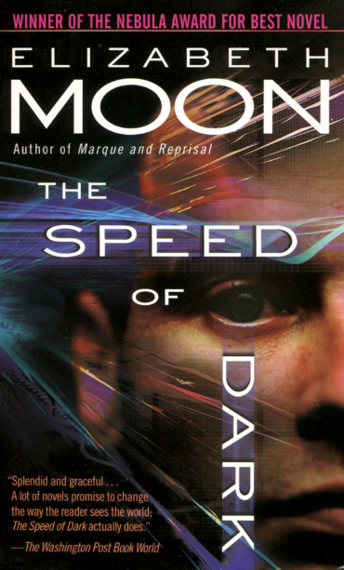
THE BOOK
The Speed of Dark won a Nebula in 2003. It’s billed as Flowers for Algernon, but for autism. That means it’s about a speculative cure for autism. We’re already off to a great start to representation with that.
What if you could get your autism cured??
That question is typically followed up by people asking, “But what if I lose myself?”
In The Speed of Dark, Elizabeth Moon answers the question with, “Worth it!”
The main perspective character and narrator is Lou Arrendale, an autistic informatics specialist. His job sounds like what the people in Severance do: work with patterns that other people can’t see, in ordinarily-incomprehensible data. Unlike in Severance, this is a really good job. Lou lives the bachelor life in a nice apartment, owns a car (a big deal in this imagined future), and has friends and hobbies. This is a successful guy. The book tells us that he’s doing a lot better than plenty of ‘normal’ people.
As for his POV— It’s great. When I first started reading, my impression was that Moon was nailing it. The beginning was full of promise.
And then the plot happens. Darn.
THE PLOT
Lou is a creature of routine. He drives to his office in the morning, puts his music on, hyperfocuses at his work PC for hours, eats dinner always at the same pizza place, grocery shops on Tuesday, has fencing club on Wednesday, and goes to church on Sunday.
At work, Lou is part of Section A. His team members are also autistic. They are doing super good, until one day, their immediate boss gets a new boss, and that guy is an asshole. His name is Mr. Crenshaw.
Mr. Crenshaw is one of those people who resents accommodating anyone. The curb cutter effect would probably make him retch. Disability supports are a waste of the company’s precious money—never mind that everything Section A utilizes was paid off ages ago. Really, what pisses Crenshaw off is seeing someone else get “entitled.” Entitlement is only for him! Nothing Lou’s immediate boss says about Section A’s productivity—or the tax break the company gets for employing disabled people—can sway him.
Per Lou: “It is the pattern of people who do not really believe we need supports and resent the supports. If I—if we—did worse, they would understand more. It is the combination of doing well and having the supports that upsets him.”
In taking over Section A, Crenshaw’s pet project is to force his entire staff into being guinea pigs for the autism cure, under threat of being fired.
You’d be forgiven for thinking the book is about Lou navigating this situation. But actually, it’s at least 70% about his fencing club.
THE AUTISM
Starting with the things that I think hit the mark, and how they’re showcased, narratively:
- Sensory processing differences
- Lou’s constantly paying attention to textures, smells, sounds, and light. He doesn’t filter these things out well; they can distract him during conversations. I recommend using this tactic when writing an autistic POV because it also lends itself to some nice viscerality and sensory descriptions. It’s immersive.
- Coping mechanisms
- Lou turns to classical music when upset. His calmdown ritual is to bounce on an exercise trampoline with his earbuds in. This read as real to me. Autistic people do commonly have calmdown rituals. (So do allistic people, but it’s maybe less noticeable: less ritualized, less repetitive.)
- Attention and focus
- Lou tells us that Bach synergizes with the pattern-matching he has to do for a particular work project. The way that Lou uses music like another limb stretches my suspension of disbelief. But maybe that’s just me. It read well enough.
- It’s true that autistic people, like ADHD people, are known for hyperfocusing.
- Justice sensitivity
- I dunno why this applies to so many autistic people, tbh. Lou holds strongly to his personal values. He cares about fairness. He’s honest and strict about it, down to minutiae.
- Maybe it’s more that, while everyone’s sensitive to unfairness, autistic people, who can be worse at regulating their emotions, have trouble tempering their reactions? Maybe it’s that we’re slower to notice when we’re rocking the boat? Autistic people may be more likely to call out injustice, get mad about rulebreaking, and refuse to let things slide. In a way, these are examples of empathy. On the other hand, these exact behaviors can make others uncomfortable. They can look like a failure to read the room.
- Intelligence
- Moon understands that autism isn’t universally linked with intellectual disability or savantism. Though she makes Lou a genius at patterns anyway.
- Focused interests
- Once Lou becomes aware that he’s being pressured to ‘volunteer’ for the autism cure, he sets out to learn how his own brain works. He does this by starting from a high school level biology education and spending hours every evening reading, working his way up through recommended texts, until he’s basically completed an undergraduate curriculum inside of a month.
- I think, for some people, there’s maybe overlap with coping mechanisms here. A special interest is a topic you enjoy thinking about, so you reach for it when you want to feel good, so it’s also a coping mechanism. And we love our ritualized coping mechanisms, so we squeeze them for all they’re worth. Time dedicated + obsession = expertise. See: hardcore anime enthusiasts.
- Social anxiety
- I gotta give Moon this one. Yes, being on a different wavelength from other kids during your developmental years, expressing/experiencing emotions on a different register, and the resulting social isolation will fuck you up.
THE ““AUTISM””
All of that being said…
- Why the hell is Lou always COUNTING EVERYTHING. Why is this always the go-to sign of autism in fiction?
- I asked the group chat. Apparently, this is the fault of Rain Man (1988, film).
- CONTRACTIONS – Lou barely uses them
- The strat that Moon picks for giving her autistic characters stilted speech is to limit their use of contractions. All of them. Firstly, it’s nice when different characters have distinct voices. Secondly, why??
- Because this stiltedness is standing in for abnormal prosody. “Abnormal prosody” = talking weird. Prosody is intonation, rhythm, volume, etc.—characteristics of speech. If you want to write an autistic character, have fun with this. Custom tailor the quirks. Speech is super nuanced and complicated and influenced by social norms. Ergo, it’s one of the most noticeable things that people with the “bad at social norms” neurotype miss the mark on, particularly in childhood. There are characteristics of “autistic speech” that crop up commonly. You can listen to some podcasts or YouTube videos made by autistic people to get a feel for them. But no two people will be wholly alike.
- FIGURATIVE LANGUAGE – Lou keeps telling us he doesn’t understand it. Oh my god. Just, enough of this kind of thing, please.
- It’s rules. Language use is rules. Who wants to say with their full chest that autists are bad at rules?
- Lou is so smart. He reads books. Why is he struggling with cliché turns of phrase in his 30s?? Why does he have to turn to the camera and break them down whenever they appear?
- Lou does not know this human emotion you call HUMOR.
- What a chronically unfunny guy. He also points out all the times he doesn’t get jokes. Really feels like Moon’s going the Beep Boop Human Robot route in this regard.
- If autists weren’t funny, where would The Verge get content?
- There’s a lead shield between Lou’s brain and the concept of SOCIAL SIGNALS.
- This becomes more prominent as the book goes on. Surely, the guy who reads a biology textbook in three days can apply some of his intellect to improving his theory of mind.
- Seriously. There are flashcards for this. Little children are drilled on them. And the gold standard is asking. That’s such an easy rule to memorize. C’mon.
- Beep boop robots again – Autistic friendship is a misnomer
- There’s an early scene where Lou and his autistic coworkers in Section A go for dinner at their designated pizza place. They eat in silence, “not needing to communicate with each other.”
- This made me roll my eyes. I showed the scene to my husband. He also rolled his eyes. “What would actually happen,” he said, correctly, “is that they wouldn’t shut up!” (This wasn’t a targeted attack on me! He also has an autistic younger brother.)
- You try to get a tableful of autistic people together and not end up listening to an excited monologue about the entire plot of the Gundam franchise, or homebrew Dungeons & Dragons classes, or their childhood trauma, or the HDG web series. Go on. I double dog dare you.
- Perpetually ARRESTED DEVELOPMENT
- The book doesn’t acknowledge the notion that Lou could improve his social skills. Lou’s just stuck. He’s bad at close friendships, lives on a different planet from the concept of emotional intimacy, and is explicitly incapable of romance.
- In reality, even if you suck at something, you’ll get better with effort. Wild concept, I know. Lou’s interpersonal skills should have matured, because that is simply how life experience works. The dude’s like, 30-something.
- He’s got a big crush on Marjory, a lady from his fencing club. In this context, Lou mournfully thinks to himself that he could never have a wife, since he can’t handle sharing living space with another human. Maybe that was an autistic stereotype before the Great Recession. In this economy, you suck it up.
THE PLOT, CONTINUED
The plot is Lou’s fencing club. I’m serious. For a good 3/4 of the book, Crenshaw’s eugenics scheme is barely a blip on his radar. (The “autism cure” subplot is mostly told through short scenes from the perspective of Lou’s sympathetic boss, until we shift gears at the end.)
It’s crucial to understand that this story is taking place in a world changed by select near-future technology. I said eugenics earlier. There are all kinds of sprinklings of eugenics in here. “Certificates of stability” being needed for marriage are mentioned. The main speculative element is that we will cure autism in the future. Don’t lose sight of this.
You see, Lou is one of the last people to even “need” the cure for autism. He’s also already a beneficiary of futuristic autism treatment. (Are we supposed to think that he couldn’t have achieved his level of functionality without treatment…? Like, just saying, I don’t remember my therapists doing anything helpful.) A few years after Lou was born, early childhood intervention advanced to the point of shepherding autists through normal brain development, virtually erasing their symptoms. There will be no more autistic generations. Okay…
More darkly, we’ve also developed a brain chip that corrects personality problems by restraining behavior! What a neat thing to have matter for the span of approximately two chapters. Moving along—
~~Spoiler time!!!~~
The cliffsnotes:
Lou is sooo good at pattern matching that it makes him awesome at fencing. He impresses everyone at his fencing club. Including a pretty lady named Marjory. Alas and woe, no matter how much she’s into him, he’s simply too autistic to cope with a relationship.
Simultaneously, the fencing club organizers convince Lou to try out tournament competition. He does well. He’s encouraged to keep competing. But, alas x2, his autism is an insurmountable obstacle. The tournament was scary!!! (Again, he did really well; everyone said so.) But it was anxiety-inducing the first time Lou tried it, so it can’t be part of his life.
Despite this, a man named Don is still very jealous of Lou’s apparent successes. Don’s in Lou’s fencing club, but he sucks. He feels worse about himself knowing that someone like Lou can be good at things. Don is explicitly neurodivergent. He’s portrayed as having ‘dark triad’ personality traits. (Moon doesn’t use that descriptor.)
The central conflict in the book is Don’s furtive, escalating harassment of Lou. First, he slashes Lou’s tires. Then, he smashes Lou’s windshield in a drive-by. Lastly, he replaces Lou’s car battery with an explosive device. The police have become involved by then, and draw the obvious conclusion that the culprit is connected to Lou’s fencing club, because of the timing of the vandalism. But Lou has to be dragged to that conclusion. He doesn’t want the culprit to be Don, so he throws up a mental block against the evidence.
(Meanwhile, Lou’s sympathetic boss is skittering around in the “autism cure clinical trial” subplot, and Crenshaw’s throwing his authority around like an asshole, delivering “ableist supervillain” lines with a straight face.)
The police bring Lou around to the culprit being Don. They tell Lou to be careful. Lou then goes to the grocery store on his typical Tuesday night, exactly when Don knows he always goes. Don attacks Lou in the parking lot with a gun. Lou uses his Superior Autistic Pattern Matching to disarm Don with a barehanded fencing move. (I know it sounds like I think this is stupid— In actuality, it gets a Rule of Cool pass from me.)
Don’s arrested. He’s implanted with the brain chip that will make him unable to do bad things anymore. Lou is mildly creeped out by this. The plot moves along. With the Don issue resolved, we can get back to the “autism cure” issue.
Here is where it really falls apart <3
THE CURE
Moon does like half a dozen things to telegraph that the researchers aren’t completely competent or trustworthy. On top of Crenshaw’s blatant coercion, there are all kinds of good reasons for Lou to not jump into this clinical trial. There’s a scene where the researchers sit down the Section A people for a presentation on the procedure and just totally whiff it.
Here’s what Lou has to say, in the big presentation scene:
“Who I am is important to me,” I say.
“You mean you like being autistic?” Scorn edges his voice; he cannot imagine anyone wanting to be like me.
“I like being me,” I say. “Autism is part of who I am; it is not the whole thing.” I hope that is true, that I am more than my diagnosis.
“So—if we get rid of the autism, you’ll be the same person, only not autistic.”
He hopes this is true; he may think he thinks it is true; he does not believe absolutely that it is true. His fear that it is not true wafts from him like the sour stink of physical fear. His face crinkles into an expression that is supposed to convince me he believes it, but false sincerity is an expression I know from childhood. Every therapist, every teacher, ever counselor has had that expression in their repertoire, the worried/caring look.
What frightens me most is that they may—surely they will—tinker with memory, not just current connections. They must know as well as I do that my entire past experiences is from this autistic perspective. Changing the connections will not change that, and that has made me who I am. Yet if I lose the memory of what this is like, who I am, then I will have lost everything I’ve worked on for thirty-five years. I do not want to lose that. I do not want to remember things only the way I remember what I read in books; I do not want Marjory to be like someone seen on a video screen. I want to keep the feelings that go with the memories.
There’s a brief discussion where Section A realizes that the clinical trials are being sped up. The researchers won’t be waiting to make sure the first batch turns out okay. They’re putting as many people through the procedure as fast as possible, in case their permission for human experimentation gets rescinded. Um??? Concerning???
Turbo spoilers: Lou’s right to be wary, but signs up anyway! Despite all the waving red flags!! RIP to my suspension of disbelief.
“I think I might want to try this treatment. I do not have to. I do not need to; I am all right as I am. But I think I am beginning to want to because maybe, If I change, and if it is my idea and not theirs, then maybe I can learn what I want to learn and do what I want to do.”
See, this only tracks if you accept the premise that being autistic is an insurmountable obstacle to Lou self-actualizing. But didn’t we already establish he’s doing great?
Lou gets the treatment after page 321. The book ends on page 340.
THE END
The final chapter squicked me the fuck out. Post-treatment, Lou’s regressed to infancy. His brain is having to rebuild connections from practically the ground up. He needs his butt wiped for him. He doesn’t recognize his friends.
One of the other Section A people never gets better.
Eventually, months later, Lou recovers. But. There’s a pivotal scene that does a Flowers for Algernon thing, where cured!Lou hides in a bathroom and hallucinates Lou-before as a separate person.
Cured!Lou explicitly conceptualizes himself as a separate person.
Here is what it looks like, for Lou to not be autistic anymore:
- Gets bored of routine
- Picks up on social cues effortlessly
- Weakened pattern recognition
- Alterations to sensory integration
- Not interested in calculating
- States his emotions in plainer words
- Heightened empathy, ability to model other people
Dude, that’s it? That’s all? And at what cost.
The epilogue is ~330 words.
There’s a timeskip: Cured!Lou has quit fencing club. He quit his job. He left his life. He gave up his friends. He gave up Marjory. Nevermind her anyway, because he’s a different person, and he doesn’t love her. He’s an astronaut now!
The old Lou haunts him like a ghost. But that’s fine. They’re happy! Hurrah, it was worth it. Cured!Lou is blasting off into space.
“It bothered Lou-before that the speed of dark was greater than the speed of light. Now I am glad of it, because it means I will never come to the end, chasing the light.”
THE TAKEAWAY (…? really?)
Apparently, however sad it is that Lou-before was erased, it’s great that Lou-now has been cured of what ailed him. Autism held Lou-before back from his true potential. The autistic Lou couldn’t have chased his dream of going to space— Which I forgot he had before the timeskip, because the book frankly doesn’t mention it much.
I’m just saying, neurotypical people are allowed to squander their “true potential” without dangling what-if scenarios where it’d be awesome if they got bodysnatched by a superior version of themselves!
I’m just saying, Lou was worthwhile already. We were even shown that others found his life enviable.
I’m just saying, as a married autistic guy, I was never gonna buy into the premise that autists can’t have intimate relationships. Come the fuck on.
In conclusion: I think that The Speed of Dark was aimed at a bullseye labeled ‘inspirational,’ but kept hitting the ‘horror’ ring instead. And that the author misread the points when she went to tally the score.
#
Next up: The Kiss Quotient. This is an acquaintance’s favorite book. I promised her I’d read it and tell her what I think about the autism. Plus side: Actually written by someone autistic. Minus side: I feel the way about romance stories that small children feel about vegetables. (Picky as hell. Generally need them disguised. Please grate the zucchini (smooching) into chocolate cake (speculative fiction).)