I spent most of this month reading slush. Expect something about that in like, half a year.
My workload in fiscal year 2027 looks like it’s going to be normal??? I’m already able to take lunch breaks again?? I don’t want to jinx myself, but having a normal amount of free time would be incredible. I might actually get a story draft to the point where I’d let someone else see it.
Short stories and essays
“I found it: the best free restaurant bread in America” by Caity Weaver
I think I am immune to the allure of celebrities, and then I witness someone with genius as radiant as Caity Weaver. Her article about free restaurant bread was a spiritual experience for me. I cried. This is the best thing I’ve read all year.
Yeah, I know this doesn’t follow from the title. You don’t have to believe me, just go read it!!
This felt delightfully inventive to me, someone who knows nothing about No Man’s Sky. I also really liked the narrative voice.
“The Day-Blind Stars” by Christopher Rowe
A dreamy, fairytale sci-fi about Sierra St. Sandalwood IV, who leaves the ruined earth—and her family—to journey with a ‘guard god’ she encounters in space.
“Blade Through the Heart” by Carrie Vaughn
I love that this story subverts the sci-fi thing where technology is imagined to make inexorable, universal, linear progress. Horses to buggies to automobiles to flying vehicles, everywhere, for everyone. Once something is invented, it becomes the universal standard for the setting. But that’s not at all how the real world works.
I swear I’ve read in this series before, but I don’t have a record of it, so it must’ve been a while ago. It’s a bit like Murderbot. Graff is a cyborg from an insular culture that values archiving memories. He’s part of the Visigoth, a crew that fights pirates, and dating the ship’s doctor.
“Sinew and Steel and What They Told” by Carrie Vaughn
I’m going back and rereading the Graff stories because I don’t remember them well. These are honestly what a lot of people writing MurderbotxRavi fanfic want. This is the first story, and it’s about Graff getting exposed as a cyborg to his lover and his captain after nearly dying. Pure whump.
“An Easy Job” by Carrie Vaughn
A prequel to the first Graff story. This one is about a near miss for his cover getting blown. On a routine infiltration mission, he encounters another cyborg like himself, working for the enemy pirates.
“Time: Marked and Mended” by Carrie Vaughn
More Graff whump.
“Not the Most Romantic Thing” by Carrie Vaughn
Another ‘prologue’ Graff story. This one is set a year before the first one, when his doctor boyfriend doesn’t know he’s a cyborg yet. Obviously I enjoy these. This one features a completely adorable cat rescue.
The last Graff story that I hadn’t read. Turns out this has been open as a tab on my phone for over a year. It’s about Graff’s childhood and how he got his job with Captain Ransom.
“Let’s Go to the Zoo” by Louis Evans
I think this author is on tumblr.
The only completely sane human is housed in a zoo, kept unaware of this.
“Why the verb “to be” is so irregular” by Colin Gorrie
This is the essay that taught me about kurgans and word reconstruction. A really cool read. I love learning about dead-and-forgotten stuff that experts work to figure out.
“Strawberries” by D. A. Xiaolin Spires
I don’t feel like I followed this story well. It’s a dual-timeline diaspora tale. The narrator, who’s like a space farmer, living inside a Dyson sphere, has a tattoo that whispers the memories of her Japanese ancestors.
“Bullet Time at the Kink Party” by Miriam
Holy crap, the title is literal. Okay.
I wish I could remember who it was that linked me this, five months ago. Because man, what the hell. This story is about a kinky queer orgy, crashed by riot police, that turns into a gunfight with magic, because the queer orgy participants are some kind of underground resistance force against fascist nationalists, and some of them are witches? Yeah, I think that’s it. I usually like weird stuff, but this is very sex-and-violence weird stuff. VERY sex and violence.
“Johnny Otha Has a Problem” by Margaret Dunlap
Johnny Otha’s problem is that he’s an amoral capitalist vulture whose lips are pressed to the boot of an idiot trillionaire. The trillionaire wants to start a space colony of indentured laborers. Johnny’s told the numbers don’t work; he doesn’t care. He’s told that the laborers might use their transit time in space to unionize, and so has them all drugged and put in cryopods against their will. And Johnny’s in a story that believes in karma.
“Unfortunately, I Am Wrestling With Genre Again” by Molly Templeton
An article about why or whether we draw boxes around genre fiction.
“Someone had to go first” by ‘Babs’
A short science fiction story linked by a friend. I really liked this one.
“Science Fiction is Dying. Long Live Post Sci-Fi?” by Matthew Claxton
I have a bunch of thoughts about this and limited time to type them out.
But what I’m thinking is that fantasy’s doing so well because it has a lock on wish fulfillment that fits the zeitgeist.
Sci fi wish fulfillment, vis-à-vis the classics, is, “Be a hero! Solve problems! Be the smartest! Discover things nobody else has! Stare unblinking into the unknown! Conquer the universe! And technology will make this all possible!!”
I think a lot of us are too tired for an undiluted version of that. I think Project Hail Mary was a sensation because it packaged its sci fi-ness with “make a best friend,” and, critically, the technology comes about because everybody’s working together to save the world. I freaking wish I ever encountered new technology in a context that made me happy because it was doing something good.
My reader friends are going in for cozy stories. Food, family, friends, rest, wonder, leisure, travel, art. Fantasy is doing that. Contemporary life is doing shitty cyberpunk. I can’t get away from technological innovations. Every time I open a website I used to use, it’s sprouted an AI agent like fungus. Everything is getting sleek, modern, and deeply inconvenient. Per Simon McNeil, “We got to one of the futures Science Fiction proposed, and it sucked.”
And sci fi stories often lag behind that future anyway. A lot of what gets put under my nose is engaging with what-ifs from 20, 30 years ago—presumably, when the author was first learning how the world worked. We’ll get better sci fi from authors who stay abreast of the present. Maybe while figuring out how to make promises of technology that people actually want.
Books
Project Hail Mary by Andy Weir
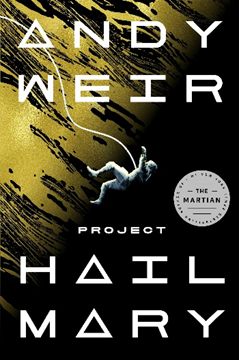
This sooooo has the Reddit voice. But I was fine with that, because I had to sneak-read it at the office, for the office book club. The digestibility was a boon.
Very notable that this broke out into the mainstream. I don’t often experience cultural moments where everyone around me is excited for something that I also find interesting. It’s fun/surreal to have a water cooler conversation about alien design. (Usually, I’m stuck pretending to know anything about sports.)
I’m very glad I saw the movie before the book. Andy Weir’s characters are not the most detailed portraits in the gallery. I don’t know if I would’ve cared for Stratt without seeing Sandra Hüller’s version of her first. The book gives us more of Grace’s feelings for his dead crewmates and wayyyy more science stuff. The movie gives us the way characters look, act, and feel; details of the environment; breathtaking visuals of space; and a couple invented features I enjoyed. The “screen bubble” room where Grace shows Rocky scenes from Earth isn’t in the book. Nor does Grace make recordings for Stratt. In the movie, her viewing those recordings and seeing that Grace made it teared me up like nothing else.
Above all, I’m grateful that this book exists and has made people love it. I want a million more hopeful, uplifting sci fi stories.
Service Model by Adrian Tchaikovsky
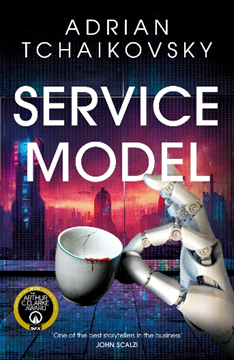
A book club pick from the longtime friend who was my very first beta reader on my very first novel project. This started out soooo slow that I might’ve bounced off, had the rec come from anyone else. It was around the end of act 2, “K4FK-R” (Kafka), that I was drawn in. 65% of my engagement is directly attributable to The Wonk.
I really appreciate that this book knew what it wanted to be and stuck the landing. It’s an absurd, modern parable about wealth- and technology-mediated societal collapse. This is what I think about on a typical Monday, when I return to my workweek of trying to help communities whose infrastructure is made of rust and rubble. Jeff Bezos’s Venice wedding blew more cash than most villages need to keep poop out of their drinking water. We are building data centers instead of keeping poop out of drinking water!! Our priorities are broken.
The main character of this book is a robot. A service model, of course. He’s a valet. The Wonk is his human companion, who desperately wants him to be sapient, because then the ascent of robots over humanity would, to her, feel like it means something. I’d describe ‘Uncharles’ as ‘self-aware within parameters.’ Maybe he’s a person, maybe he’s not. Tchaikovsky does a good job keeping his robot-ness consistent. This is not a story where the robot ascends to personhood by developing a soul. No velveteen rabbits here.
The social commentary is topical and at times whimsical. Honestly, a good read.
The Fifth Season by N. K. Jemisin
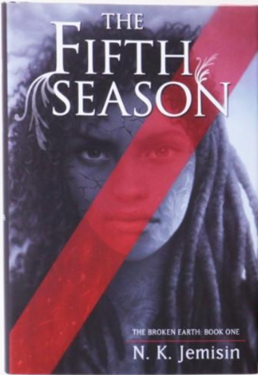
This had sort of casually been on my TBR for years, but I shoved it towards the bottom after I didn’t like all the parts in Jemisin’s The City We Became that weren’t about Bronca. So it’s a good thing that one of my book clubs picked The Fifth Season. Every speculative fiction fan should read this. The book has several extremely well-done features:
- The prologue! The opening!! The first line alone: “Let’s start with the end of the world, why don’t we?” Jemisin does not bury the lede. The prologue, in a mercifully conversational tone, gives introduces the “Stillness”—the continent in the setting. And thank you, Ms. Jemisin, for picking a descriptive and ironic name, instead of some made-up fantasy word (there are, by necessity, going to be so many of those anyway). We get an epic fantasy overview of the Stillness in a narrative tone that’s easy to read. And then Jemisin shows us what kills this world—or rather, who.
- The triple timelines!! Granted, I spoiled myself on the core conceit here. For the people in my bookclub who went in without foreknowledge, this didn’t hit. They bounced off the book before Jemisin’s narrator reveals what’s up. The book is apparently about:
- A little girl name Damaya, whose parents have discovered that she’s an earthquake wizard—an orogenes—and called for the secret police (“Guardians”) to haul her off to the Evil Institution for Wizard Enslavement (“the Fulcrum”). It’s that or kill her.
- A young woman named Syenite, also an orogenes, who’s busy climbing the career ladder at the Fulcrum. Syenite is assigned to a ‘cushy’ long-distance travel mission with an ultra-powerful male wizard mentor…because her real assignment is to have his baby.
- And the first perspective protagonist we meet, Essun, also an orogenes. Her chapters are told in second person. (You later learn which character is narrating.) The book opens right after the murder of Essun’s toddler son. Her husband realized the boy was an orogenes, killed him, kidnapped the daughter, and fled—mere days before the world was due to end. The prologue showed us the extremely powerful orogenes who cut the continent in half, destroying civilization along the populous equatorial belt. As ash fills the sky and volcanic winter sets in, Essun must navigate an increasingly chaotic landscape of refugees to hunt down her husband and save their daughter. Remember the daughter quest—we’re told it’s critical.
SPOILERS SPOILERS SPOILERS: The twist is that these three characters are the same woman, at different points in her life. I loved this. I eat this kind of character recontextualization with a spoon.
3. I also thought it was interesting that the main relationship arc in the book—Syenite and the guy she’s (horrifyingly) assigned to bear a child for—is characterized by a complex sort of intimate animosity. These are not compatible people. They do not fall in love—not with each other. At no point do they become effective communicators either, LOL. Even when they’re living together, in love with the same guy, and raising a kid with him. Yeah, this book has a polyam FMM triad! How did I not know that? I guess that, if you’re reccing books with polyam relationships to people, you don’t necessarily include examples where that romance is transitory and ends in tragedy. (You know it does, because, when you first meet Essun, she hardly resembles Syenite. And all the people Syenite loved are long gone from her life.)
This book is, however, afflicted with first installment syndrome. The end result of the triple timelines is that something like eighty percent of the narrative is backstory— Read the next book for the exciting conclusion, etc. Now, it was great backstory! I really liked seeing what the world was like and why it was ended! Jemisin did a fantastic job with the perspective she chose for each event. The reader is introduced to the hows and whys of the world through the right character, at the right time, in scenes that make the fantastical personal. There were a couple scenes in the book that outright haunted me. (Chiefly, the scene where Damaya’s Guardian brutally disciplines her—that triggered me.) This was so much better than the sourcebook mode epic fantasy often slips into, where the author decides you need a broad understanding of wayyyy too much big-picture stuff at once. But. I have to acknowledge that the “Mission: Daughter Rescue” plotline—the first goal we get, the only present-day goal that ties the narrative together—hits a wall at the 70% mark and does not move again thereafter.
Tbh, the ending crashes into you. I was reading an ebook edition that I didn’t realize included appendices and two chapters from other works of Jemisin’s. So, I thought I was at the 90% mark when I smacked into the apparent-non-sequitur cliffhanger. Wait, that’s it?? And the cliffhanger sounds silly; I spoiled myself on the point of it and still found it silly.
Ultimately, the book spends the vast majority of its wordcount setting up its premise. This’d be insufferable if Jemisin wasn’t extraordinarily skilled. But, despite how well done it was, I still don’t like it when the first book in a series doesn’t deliver payoff for something. Essun’s daughter doesn’t appear in book one. She’s very important to the series, per Wikipedia, but…mmm. I don’t know. The way book one ends, I could easily walk away. I think I need some kind of compelling present-day relationship conflict, like opposing goals or worldviews. That’s probably available, in-world? But Essun’s important present-day relationships, as featured in book one, are: 1) the missing daughter; 2) the missing husband; 3) her asshole ex-baby-daddy, Mr. Super Wizard himself, who SPOILERS shows up at the very end to deliver the cliffhanger; 4) a nonhuman enigma kid traveling with her, whose whole thing is that he’s supporting her but not saying why; 5) a resurfaced childhood friend, now a mad scientist, also traveling with her. So that’s like, two and a half people in present day, on the actual page. We don’t get all that much insight into what anyone except Essun wants, and Essun’s progress on Daughter Quest is brought to a standstill well before the end of the book.
Jemisin does do a great job signaling that Essun is on a path to discover the deepest magic mysteries of the world. I just wish I found that more compelling. I might read books two and three, but it probably won’t happen soon.
(Last thought— The Fifth Season made me really miss a fantasy book I wrote a few years ago and then never did anything with. That book accidentally plays with some of the same things that Jemisin does: apocalyptic threats, opaque magic, in-universe science, secondary world, partially urban setting. I like those things!)
The House in the Cerulean Sea by TJ Klune
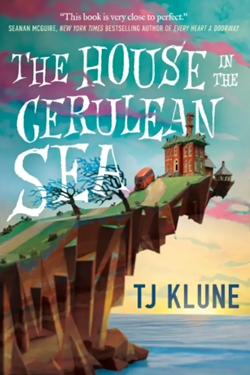
I was so glad my fantasy book club picked this for “cozy fantasy” month instead of anything D&D inspired.
This has probably been the book most rec’d to me over the past several years. It wasn’t for me, but I can see why it’s adored. The wish fulfillment is slathered on.
What I want to know is why so much in the book felt inexplicably British. Klune is from Oregon. And why the antichrist is supposed to be Satan’s kid. I’m not super familiar with biblical canon, but the Book of Revelation is one I’ve actually read, and I remember that that’s not in there. (Wikipedia’s telling me that this idea comes from The Omen and Rosemary’s Baby. I didn’t see either of those movies.)
I have to get my godson to read this one. It’s totally his thing. My girlfriend loved it too.
Comics

A finished Webtoon. This is a cozy supernatural romance between a werewolf and a time-traveling vampire. Funny premise, likeable MCs, nice art, unreliable pacing. Cute on the whole. I mostly read it because my teenage godson is a fan. This had enough going for it to vault his “ewww no romance” barrier.