Oh hey, look at how much more fun I have with 10 hours of free time back in my week. I got to read a lot this month! Yay!! I invite everyone at my dayjob to continue not heaping onto my workload. Though really, sixty percent credit goes to my double knockdown luck with the project assignment roulette. I love it when I get to issue somebody an eight-page letter of deficiencies and send them off for a few months. I extra love getting to do that twice in a row. Goodbye, god natt, see you when you’re actually ready.
With all this free time, I’m trying out a new level of organization for my public reading log. The real reason I make these lists is to keep track of stuff I’ve read. (I have a pathologically bad memory.) If I’m going to have a zillion entries per month, it’s more helpful to me if I include additional information about each story, like where I found it and what year it was published.
Spotlight on this, that I actually read today (June), but it’s time sensitive:
Science contributor Derek Lowe is calling for the public to comment on a proposed Trump “Regulation for Federal Financial Assistance,” which empowers the MAGA regime to appoint toadies to kill grants to research that doesn’t align with their agenda. If you remember, they’re a bunch of racist, sexist grifters who hate knowledge and love big oil. It’s a bad agenda, y’all.
When I was in school, I dreamed of being a scientist. And then the Great Recession put the kibosh on that. And now, this. Whatever happened to the world of tomorrow?
41 days left to beg the Trump regime to not beat the corpse of the American science institution into bloody pulp.
Short stories – science fiction
“Unauthorized Bread: Real rebellions involve jailbreaking IoT toasters” by Cory Doctorow
Ars Technica, 2020
I don’t know of anybody else doing near future sci fi like Doctorow. I love his stuff. He has his finger on current technology and its social and political effects: Sci fi as a lens for examining our world. That’s basically what I read sc fi for. He explores true-to-life problems using human, sympathetic characters.
This novella drills into the internet of things, power dynamics, subscription models, rent-seeking, and the legal framework in the US that enables this malfeasance. Plus climate refugees, class stratification, racism, grassroots organizing, and, of course, jailbreaking. I could hardly make myself put this down. I read it wayyyy too late into the night and then got caught by my boss with my nose in it twice the next day. This is both real and prescient, wide-reaching and personal. One of my favorite reads of the year!
“Deficiency Agent” by Andrew Liptak
Future Tense Fiction, 2026
Military sci fi. A story about AI that is actually, recognizably about AI, and not magical machines with souls! Refreshing! I also read the response essay here.
“The Trick to Taking Over the World” by K. Lynn Harrison
khōréō, 2026
A woman, lucky enough to survive in a rolling apocalypse with her children, ends up leading a group of followers desperate for divine reassurance.
“We Contain Multitudes” by Geoff Holder
The Daily Tomorrow, 2026
A story about astronauts turning into plant people.
“Joiner and Rust” by Lavie Tidhar
Reactor, 2026
This starts out doing sci-fi concepts applied to folktales and the supernatural. I loved those things in Den-noh Coil (anime, 2007). This story has a Martian robot, a talking cyborg cat, and digital ghosts made from corrupted memories that can infest a river of sludge. The robot, Rust, journeys into the mountains of Qijiang, meeting up with his counterpart, Joiner. Then we start a flashback into their time as war machines, transitioning into them joining up with a motley space pirate crew after the war ends. Ultimately, this story is pretty meandering, covering multiple centuries of these robots’ existence. But at least none of the information we get about the world is boring.
I’m gonna have to give out another technical pass for the “AI as people” trope. Joiner and Rust didn’t have to be robots, really. The plot just needs them to be functionally immortal and to survive something that killed their human crewmates. They’re otherwise just humans in tin suits.
“a testament to indirection, an enigma, the sun above” by Mitchell Shanklin
Lightspeed, 2024
Flash fiction that starts in the middle of brain surgery. The narrator is tasked with editing the ‘poem’ that comprises their partner’s personality.
“The Great Server Farm in the Sky” by Natalie Paris
Litro, 2026
Damn, this was something else. It’s about the afterlife as virtual reality. And dead teenagers.
“COPY <|> PASTE” by Derin Edala
Indie webfiction, maybe I’m just dumb but I can’t find where this blog shows publication dates
A top favorite of the year. I LOVED this one. It nails a compelling spin on classic sci fi tropes. You have a teleportation gate. You go through it, come out the other end. BAM, faster-than-light travel.
Edala asks: So you’re get converted into data, right? And then your mass is reassembled on the other end? So what if you just…kept the data in the system? And reassembled on the other end again? And again? What if your name is Kate, you’re a foldgate engineer, you’re on a distant, hostile exoplanet, your foldgate connection to Earth has snapped, and the rest of your crew is dead? You’re alone. What if you want to survive? What if you jailbreak the foldgate? What if you force it to just keep making copies?
Welcome to Kateopolis, population: Kate.
This story really stuck in my brain. I couldn’t put it down. Got caught with it at the office by my boss, twice. Edala presents an intensely human exploration of Kate society from the perspective of different Kates across decades. On top of fleshing out the science of the speculative elements, we get to drill into the friction caused when a ruthless, pragmatic personality is pitted against herself on the scale of a small village. I love the Kates and their problems. This was GREAT.
“The Stars Look Away From This Vessel” by Dave Ring
Lightspeed, 2026
I wish I had followed this one more than I did. It’s one of a few stories I read this month that goes into these frequent, detailed prose descriptions of imagery that make me wish the thing was a comic instead. I think this is about two guys who go to loot an abandoned space station—which is broadcasting a clearly haunted distress signal—and get themselves lethally irradiated.
“The Terrarium” by Caleb Biddulph
Less Wrong, 2026
In this story, a terrarium of AI agents, created to solve math problems, engages in seemingly anything but that. I agree that AI is not a machine designed to be useful. I am always less-than-thrilled when a service sprouts an AI button.
On that note, Here We Go appears to be a solid alternative to Google Maps, which has been steadily enshittifying to the point of unusability for years. This is the month its cumulative degradation finally became annoying enough that I was motivated to find an alternative. Here We Go doesn’t do everything that Google Maps used to do for me, but I don’t even care anymore.
“Being John Rawls” by Scott Alexander
I’m so darn sorry for reading ‘rationalist’ fiction twice in one month. I promise this won’t become a habit. This is a weird, Inception-esque story about karma.
“Bots All the Way Down” by Effie Seiberg
Lightspeed, 2026
A ‘dead internet’ flashpiece. It swerves away from what I thought it was doing by instead having the bots start talking to each other, because they’re wonely. =((((( We don’t find out why the humans stopped interacting with the botslop the AIs were created to produce. Could easily be as simple as botslop being a waste of everyone’s time.
Honestly, I never enjoy “What if the program had FEELINGS???” stories.
“Deathcap” by Lara Elena Donnelly
Reactor, 2026
This is a “space marines being hunted down by the Alien” story, but like, really sexual. The author is inspired by the crab hacker barnacle. If you’ve never heard of parasitic castration before, I am so deeply sorry to be the one to let you know the world has this particular darkness in it. This story presents a particularly horrific take on that idea, with rape as a vector for the parasite’s spread.
“The Perpetual Post” by Isabel J. Kim
Reactor, 2026
Executes its premise with rapid-fire microscenes, bouncing back and forth between past (for character context/motivation/emotion) and present (the action), per Kim’s usual. This often works well. The fantastical universe in this story has a grandiose scope, though it’s pinned to one twenty-something year old, Hanna. It was an interesting choice to dig deep into Hanna’s backstory with the exception of how she got into space. Such a crucial part of the premise, deliberately elided.
In the end, it makes sense why the scope of the story was pinned on young Hanna. The main speculative elements are a benevolent, precognitive supercomputer playing chess with human civilization—Hanna’s boss, savior, maybe-friend, and contemporary—travel by relativistic engine, which causes Hanna to age like seven years over the past five thousand; and schematics for faster than light travel, kept secret on Hanna’s dead birth planet until humans are “ready” for them.
That’s a lot going on, and the key elements definitely don’t get an even of justification. But I liked this story overall. Going to give it a pass for its “AI with emotions.”
“Wire Mother” by Isabel J. Kim
Clarkesworld, 2025
This was actually the last short story I read in May. It’s about Cassie, who has a ‘disorder’ where she can’t see her AI ‘mother’ as a person. Cassie’s dad made both her and AMY, except AMY is a human simulacrum designed to be his ideal wife, who pilots a rented body three nights a week so Cassie’s dad can touch her. Cassie hates all of this and hates her fake mother.
The title’s a banger, but I don’t see how it fits the story’s themes? There is no cloth mother. Nor does Cassie seem to get anything from AMY, even resentfully. Anyway, this is another ‘AIs as people’ story. It’s above average though. And at least it’s not going, “And wouldn’t it be wonderful if the AI loved you???”
“Person, Place, Thing” by Marissa Lingen
Clarkesworld, 2026
A deliberately vague short story about a hivemind alien—I think it’s spaceship shaped—and its mission to communicate with humans.
“Cutting Corners” by Yoon Ha Lee
Reactor, 2026
This is the Ninefox Gambit guy. I liked this story well enough. It’s about a team of pilots trained to take over for dead AIs in a war, because otherwise, the now-brainless ships the AIs once inhabited would go to waste. Times are desperate.
The characterization is good, but there sure are an awful lot of people to keep track of! The ending at least flows naturally from the premise.
“This Is Not My Timeline” by J. R. Dawson
Reactor, 2026
A story about queer refugees who are forced to leave home for another, safer timeline.
“Constellations” by Jeff VanderMeer
MIT Technology Review, 2026
A story about astronauts stranded on a lethal planet, hiking a great distance in hopes of rescue.
“Time Management” by P.A. Cornell
Lightspeed, 2025
A cute, slice-of-lifey sci fi story. Gwen discovers she can manipulate time and uses her power to dilate the good moments.
“Rupert Weard and the Case of the Adamant Annihilist” by Rob Gillham
Escape Pod, 2024
Boswell the giant, talking rabbit and Rupert Weird, PI, are up against the mad programmer whose Lovecraftian code is collapsing alternate dimensions across known reality. This was a fun piece of weird fiction.
Short stories – fantasy
“I Spin Records Into Gold” by Daria Lavelle
Reactor, 2026
In the 1970s, in Las Vegas, Nevada, Doug Dimmadone the Devil makes a deal with a band. The band hits superstar status. The band reneges. The deal ends. The roadie, now a NASA engineer, eventually remembers.
A love letter to classic rock ‘n roll. This did the “fragmented memories from an alternate reality” trope well. I also enjoyed how grounded the non-speculative elements were. It was also pretty darn cool that this incorporated NASA’s golden record. Clever, multi-faceted execution. Wish it didn’t end with a “someone else gets the girl” sting. I don’t like that trope.
“Ten Unsent Letters to the Dark Lord” by Ada Hoffman
Lightspeed, 2026
Both an epistolary and a list story. A captured minion of the dead dark lord really, really misses him.
Lightspeed, 2020
A meandering story about a girl who’s in the hospital because, like a phoenix, she spontaneously combusts and is reborn. It happens whenever she’s angry. At the hospital, she meets another girl with a preternatural condition. They fall in love, go their separate ways, and later reunite.
“The Devourers of War; or, An Excerpt from the Cookbook of the Gods” by Oluwatomiwa Ajeigbe
Lightspeed, 2025
A modern myth story about the last major orisha traveling an apocalyptic earth to hunt down and destroy the ajogun (evil spirits). The ajogun are his kids. The orisha outnumber the ajogun, but the ajogun killed all the other major orisha, and have since been tormenting humans unchallenged.
The conversational narrative tone of this piece didn’t work for me. I’m picky!
“Tatterdemalion” by Michael Cisco
Reactor, 2026
A parable presented as an academic exploration of a traditional folktale from “Alak” culture. Did a couple interesting things to highlight the worldview of the narrator. It’s a cautionary tale about a woman of poor character who, of course, ends up dead. Has some blue and orange morality going on in the worldbuilding.
“The Dead Return in Strange Shapes” by Lowry Poletti
Psychopomp, 2023
A moody high fantasy story with loads of complicated worldbuilding. I failed to keep track of all the names.
“Year of the Tangram” by Ichabod Cassius Kilroy
GigaNotoSaurus, 2026
A moody, fabulist story about a little autistic boy and his talking tangram puzzle.
“Magical Girl: Corporate Failure” by Lia Lao
Haven Speculative, 2026
A retired magical girl story. This one’s about the girl grieving her former life and the people in it.
“The Metabolism of Grief” by Elitsa Dermendzhiyska
I thiiiiink this is an extended metaphor of a whalefall, as applied to a mom who ate her miscarried baby?
“More Than Feathers” by Phoebe Barton
Kaliedotrope, 2026
A woman survives slaying a dragon, but she’s stuck as a giantess due to enchantment, and the death of her best friend and party wizard. Fortunately, she befriends a witch.
Short stories – horror, literary, etc.
“Daddy Long Legs of the Evening” by Jeffrey Ford
Lightspeed, 2017 (Reprint from Naked City, 2011)
A horror story about a brain-hijacking spider vampire thing.
Lightspeed, 2025
Sorry, but much of popular internet culture, and especially tiktok, is radioactive to me. I could barely follow what was going on here. It’s got cannibalism?
“This Fleshy Side of the Bone” by John Langan
Reactor, 2026
An incredibly rambling story where a boy tells his friends about the time his dead dog fought an evil undead cryptid dog.
The New Yorker, 1952
A horror story about a vagabond with a masterpiece tattooed onto his skin, and the people who learn of it.
Sunday Morning Transport, 2026
A story about a scorpion who’s in love with the moon and its music. This was nicely done, but animal-perspective stories generally aren’t my thing.
“Gumba Cuddles” by David Anaxagoras
Hell Itself, 2026
A creative story told from a child’s point of view. It’s doing a twist on a vampire trope.
“The Last Sailing of the Henry Charles Morgan in Six Pieces of Scrimshaw (1841)” by A. C. Wise
The Dark, and I again failed to find a publication date
Exactly what it says on the tin. Six pieces of scrimshaw, six descriptions. The scrimshaw are basically a comic—sequential art—about what happened to the titular boat. Apparently, the captain was seduced by an evil mermaid.
“About Face” by Teresa Milbrodt
Gigantosaurus, 2026
About queer community and theater during the AIDs crisis.
“I Am a Dragon Joss Stick” by Yee Heng Yeh
CRAFT, 2026
This is an essay, but it’s also fiction told from the perspective of a 12-foot dragon joss stick, so I’m sticking it with the literary stories. Per the intro, Yeh asks, “How do you preserve a practice in the context of shifting economic, cultural, and technological realities?”
“There’s Something So Deeply Human About That” by Christina Tudor
CRAFT, 2026
A story about teenagers’ big emotions.
“Of Two Bloods” by Nisi Shawl and Cynthia Ward
Reactor, 2026
A novelette that asks, “What if Sherlock Holmes had a secret, trans, half-black, half-sibling, attending college in America?” The two main characters are both biracial and pretending to be white. They solve a mystery for a racist guy who threatens them.
The Dark
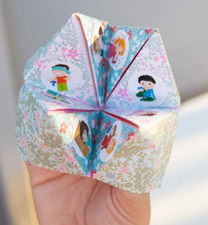
I liked this one. It’s a choose-your-own-adventure story about six murders, where you choose which section to jump to based on a fortune teller. We called these cootie catchers in school. These things:
“On the Anthology Entitled “Frames of Colour and Un-Colour”” by Dmitri Akers
Psychopomp, 2026
Another horror story told via images described in prose. Photographs of an eldritch thing in a tree. I remember where I got these now—Reactor published Alex Brown’s list of “Must Read Short Speculative Fiction: January 2026.” I’m beginning to think I’m just not into horror.
Nonfiction
“Notes on a non-profit indicted for bank fraud” by Patrick McKenzie
McKenzie is a tech and finance writer with a background in software development and banking. I debated whether I wanted to mention this essay in the context of my public reading diary. This something that made me cry this month. What I’m talking about is the functional loss of the SPLC blacklist.
If you haven’t heard—Trump is going after the Southern Poverty Law Center. And they did more than a few things that let him make inroads on his attack, which, horrifically, undermined their core mission.
“Collections: Against the State – A Primer on Terrorism, Insurgency and Protest” by Bret Devereaux
Exactly what it says on the tin. This was a good piece as a jumping off point for some research I’m (lightly!) doing for a book I’ve been struggling with.
“That’s Somebody’s Son” by Mary Margaret Alvarado
Atavist, 2026
An essay about three young men who’ve struggled with schizophrenia, informed by their mothers’ efforts to secure care for them. You already knew that the medical system in the US is a shitshow.
“There Will Be No Mercy” by Drew Philp
Atavist, 2025
This is about Abiy Ahmed’s genocide of Tigray, featuring accounts from doctors who worked through the war at the Ayder hospital in Mekelle, treating countless victims of gunfire, bombings, starvation, and rape. Will make you furious. Should make you furious.
The reporting here won the National Magazine award this year.
“Welcome to the slop sewer. Would you like to stay?” by Nicole Brinkley
I have no idea why this essay showed up in my email, but it resonated with me. Brinkley writes about the vogue culture of social media-drenched authors leaning on AI programs to generate additional content for their online presence. It’s an extreme iteration of authors chasing trends—not just churning out what you think will be popular, but stepping back and letting a program do the act of creation for you. The lack of intentionality shows in such outputs. Brinkley calls it sewage; most call it slop.
This is a quote from an earlier essay of hers, referenced behind the link, that I agree with: “I want to lean into slow content, meticulously crafted for the community that wants to engage with it. I want to ignore the algorithm. I want to be present. I want to take pride in what I create. . . . I want to read and write weird things, niche things, strange things. I want to write what I want to write.”
Books
The Works of Vermin by Hiron Ennes
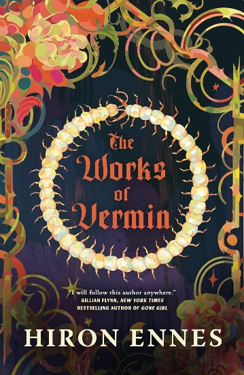
Amazing. Brilliant. Wonderful. (Blurbed on the cover by Gillian Flynn??) Literally my favorite book of all time now. This is how I want to write. Gave me hope for a bunch of semi-abandoned WIPs that I set aside cuz I thought they’d be “too weird” for the market.
The City of Tiliard is a morass of poison, crawling rot, and high culture. Tiliard is carved into a mammoth tree stump that straddles an eldritch river. From that river, monstrous insects with preternatural venoms emerge.
Guy Moulène lives in the lowest parts of this city, the rotten tree roots dangling over the river’s surface. He’s an indentured exterminator, working to pay back his debts and keep his younger sister from falling into the same trap.
Asteritha Vost is an orphaned young woman, bound by contract to the terrifying Marshal Revenant. (Think Darth Vader.) They live in the Palas on the sunlit, garden-girdled stump face of Tiliard. Aster works for her elite master as his perfumer. The potions she concocts beguile the senses of both the wearer and his audience. Aster’s perfumes can confer beauty, genius, elocution, charisma, strength, and salvation; or peace and dissolution.
This is a fabulous dual timeline story. Ennes does the exact kind of twist I love love love in anything—an earthshattering recontextualization of character identity. I’ve got a character identity upheaval in my current WIP, which I’m now reworking, having learned from Ennes’s example. I wanna do dual timelines too!! Ennes got away with putting a twist on them, so surely I can get readers to be patient with a more straightforward execution of the same, right? It was just such a good tool for expanding the context of the world, through the eyes of different main characters. Now I can’t imagine why I ever tried to do my current WIP with just one timeline from one POV.
Flowers for Algernon by Daniel Keyes
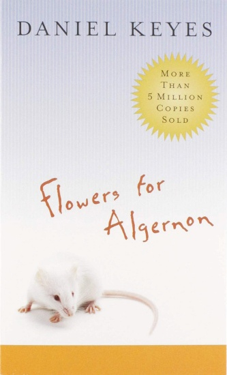
My ~*♡Girlfriend ♡*~ read this aloud to me during a road trip to and from St. Louis. This was a Bro Squad Book Club pick. I appreciate that it made a bunch of grown men cry.
The story’s told via journal entries. Set in the US in the 1960s, the premise is that Charlie Gordon, who is high-functioning with mild intellectual disability, is selected as the first human test subject for an experimental treatment to induce intellectual growth. Charlie’s a warm, endlessly kind guy with a great work ethic. The mouse Algernon is one of the animal test subjects. The two bond.
Keyes deftly uses Charlie’s journal entries to characterize his meteoric rise in intelligence—and the fall afterwards. (I’m not gonna say “SPOILERS” for a 60-year-old twist.) Charlie’s own research, performed at the peak of his intelligence, reveals that the procedure won’t “stick.” Over the course of nine months, from hopeful inception to final deterioration, he grapples with his emotions, sexuality, relationships, memories, values, purpose, and identity. Charlie, as a character, remains the best advocate for intellectual disability that I’ve seen in fiction. The affirmation of his personhood before the procedure, and the deservedness and humanity of all intellectually disabled people, are central, explicit narrative themes.
One thing that stuck in my mind is the Warren Home. This is the state-run assisted living facility that Charlie was consigned to as a child, and that he knows he’ll return to if his deterioration leaves him worse off than before. Charlie tours the Home and finds it to be an extensive campus of dorms, workshops, farms, schools, and other facilities, caring for something like 4,000 residents. That’s an entire community. We see some residents providing support for each other. I don’t think these facilities exist at this scale anymore. The Warren Home is definitely an idyllic conception of institutionalization, with no apparent signs of abuse.
I read Flowers for Algernon for the first time cuz it was assigned summer reading for my cousin “Max” when he was entering 8th grade. He refused to crack the spine. I think I remember trying to dictate the answers to his homework packet, and him being a huge gibbering baby about it. “I’m booooored,” he whined all damn morning. Okay, bro, then DO something. “I don’t wanna write down the answers, that’s booooooring.” We established you were already bored. You were bored ten minutes ago, and all morning, and all yesterday, and all week so far. Why not make an A on your homework while you’re at it??
Max didn’t suffer under the flavor of parental dysfunction I did, but he apparently ended up worse off out of the two of us. Though I never saw him again after that summer, what I was told (albeit via an unreliable source) is that he was diagnosed with brain damage. What I remember is him hitting his head a whole bunch of times, by jumping off of playground equipment, down stairs, and etc. He’d try to drag everyone into those stupid games. Child!Me indefatigably resisted the peer pressure to participate. The last update I got was that Max was too emotionally disturbed and unmotivated to make it through his first year of community college, so he was dropping out to learn an instrument and start a garage band. (Lol…)
The Girl Who Fell Beneath the Sea by Axie Oh
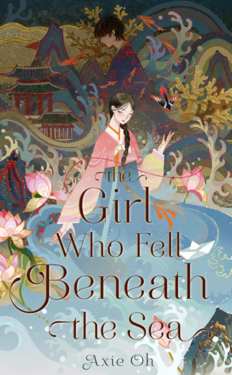
A YA fantasy billed as appealing to fans of Spirited Away (the Miyazaki movie from 2001) that’s retelling a Korean myth. And yup, that’s exactly it. The organizer of the fantasy book club I’m in love love loved this one.
Heroine Mina volunteers as tribute to the Sea God to get her brother’s girlfriend, OG heroine Shim Cheong, off the hook. Every year, their people throw a bride for the Sea God into the ocean, in an attempt at appeasement. The Sea God’s been ignoring prayers since the emperor was killed a century ago. Now, Mina’s homeland is ravaged by drought and storms, provoking countless wars. (Almost strictly offscreen.)
Mina’s journey takes her to the spirit world. This book has soulmates, red strings of fate, and, of course, hot guys who turn into mythical beasts. I could tell Oh likes anime before her author blurb told me so. The narration is that extremely immediate, fast-paced first-person present tense style. The story’s very theatrical. Characters run on and off screen as needed. Pretty boys who transform into demon snakes attack whenever things slow down for a second. Mina frequently hares off after whatever plot event is scheduled next, sometimes for no apparent reason. Not to say that this story isn’t competent; it’s eminently readable. Mina’s motivations are clear; her agency is strong; her love for her family is sympathetic; and the author’s committed to the themes. Though I’d say there are too many dang characters, Oh clearly loves them all.
Almost Nowhere by nostalgebraist
This is not a book. It’s serialized webfiction posted to AO3. However, it’s 320k, and that’s like four books, so I’m putting it here. I did not read this whole story! I started reading on a 13-hour flight three years ago, skimmed from around chapter 24 onwards, skipped most of the middle, and knocked out the ending this month.
What I like about this story is that it’s 1) relentlessly weird and 2) refuses to hold your hand about it. What I don’t like is that a lot of important plot elements happen offscreen, and then we get a scene of characters explaining those things to each other. Also, there is so much fat that could’ve been trimmed.
But I really liked the Annes—iterations on a young woman, confined to a tower in a reality warp. The Annes are raised on books and strategy games by an alien entity who’s been contaminated with humanity. The alien’s hoping to make that contamination go both ways, so an Anne will turn out alien enough to mindmeld with him and plead humanity’s case to his people, who have all humans imprisoned in sundry reality warps, called “crashes.” The plot has various Annes escaping, breaking into other crashes, traveling through time, disrupting the system, and working in ouroboros loops, facilitated by journals that let them communicate with each other.
The AO3 tags include First_Contact, Alien_Cultural_Differences, Weird_Plot_Shit, Time_Shenanigans, Psychological_Drama, Moral_Ambiguity, and Non-Linear_Narrative. In that sense, this could’ve been grown in a lab for me.
Comics
The Leaning Girl by François Schuiten and Benoît Peeters
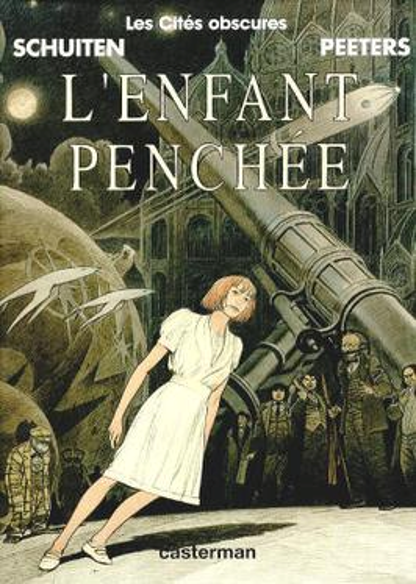
This is the sixth volume of Les Cités obscures, a Franco-Belgium comic series. (I have a soft spot for BDs. You do too, if you like Tintin, Asterix, Moebius, or the Smurfs.) The Obscure Cities series features retrofuturistic speculative fiction vignettes, often with alternate history elements. Each volume tells a standalone story.
The Leaning Girl is Mary von Rathen, daughter of an industrial magnate and native to a fanciful world. A strange event links her to our world, causing her physics-defying posture. Her family reproves this behavior. They pack her off to boarding school, where she’s mercilessly bullied. That starts Mary’s journey through the wilderness, the seedy underbelly of a city, to a circus sideshow, an astronomical observatory, aboard a rocketship, and finally, a subterranean landscape of celestial spheres, where she meets the Victorian artist from our world who’s been seeing her life in his dreams.